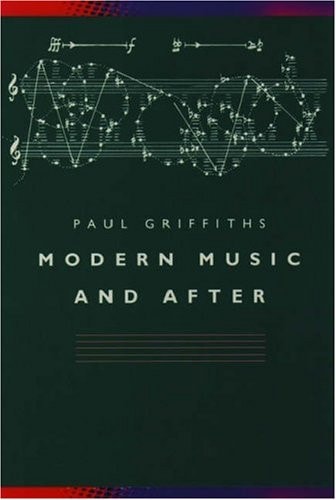
Modern Music and After
0
0
As an Amazon Associate and affiliate partner, Menrva Books earns from qualifying purchases. Learn more
Author Description
This fully revised new edition re-establishes Paul Griffiths's survey as the definitive study of music since the Second World War. The disruptions of the war, and the struggles of the ensuing peace, were reflected in the music of the time: in Pierre Boulez's radical reforming of compositional technique and in John Cage's move into zen music, in Milton Babbitt's settling of the serial system and in Dmitry Shostakovich's unsettling symphonies, in Karlheinz Stockhausen's development of electronic music and in Luigi Nono's pursuit of the universally human, in Iannis Xenakis's view of music as sounding mathematics and in Luciano Berio's consideration of it as language. The initiatives of these composers and their contemporaries opened prospects that have continued to unfold. This constant expansion of musical thinking since 1945 has left us with no single history of music. Paul Griffiths's study accordingly follows several different paths, showing how and why they converge and diverge. In addition to the composers mentioned above, others whose music is discussed include Steve Reich, Jean Barraque, Elliott Carter, Olivier Messiaen, Gyorgy Kurtag, Harrison Birtwistle, and Gyorgy Ligeti. Publication and recording details are given for the works of all these composers and many others. For its breadth and wealth of detail, Modern Music and After will appeal to both the student and the general reader in search of a lively and comprehensive introduction to the music of our time.
Menrva's Summary
THE THESIS
This book investigates the complex evolution of Western art music from the end of the Second World War to the present day, questioning how diverse compositional philosophies have shaped the modern musical landscape. Paul Griffiths, a distinguished music critic and author, utilizes his extensive knowledge of 20th-century repertoire to synthesize the disparate movements of the post-war era. He argues that the lack of a single, unified history necessitates a multi-path approach, examining how radical experimentation, serialism, electronic innovation, and mathematical structures have redefined the boundaries of sound.
THE SCOPE MAP
What You Will Find
- Detailed analysis of post-war compositional techniques including serialism and electronic music.
- Biographical and stylistic profiles of influential figures such as Pierre Boulez, John Cage, Karlheinz Stockhausen, and Iannis Xenakis.
- A thematic exploration of music as language, mathematics, and human expression.
- Comprehensive publication and recording references for major works discussed throughout the text.
THE AUTHORITY PERSPECTIVE
Experts and critics consistently identify this work as a foundational survey for understanding the complexities of contemporary classical music. Readers frequently note the academic rigor of the prose while appreciating the author's ability to maintain clarity across a vast and challenging subject matter.
Page Count:
392
Publication Date:
1995-12-28
Publisher:
Oxford University Press
ISBN-10:
0198165781
ISBN-13:
9780198165781
Music
20th Century
Humanities
Music theory
Music History
Community Tags
Similar Books