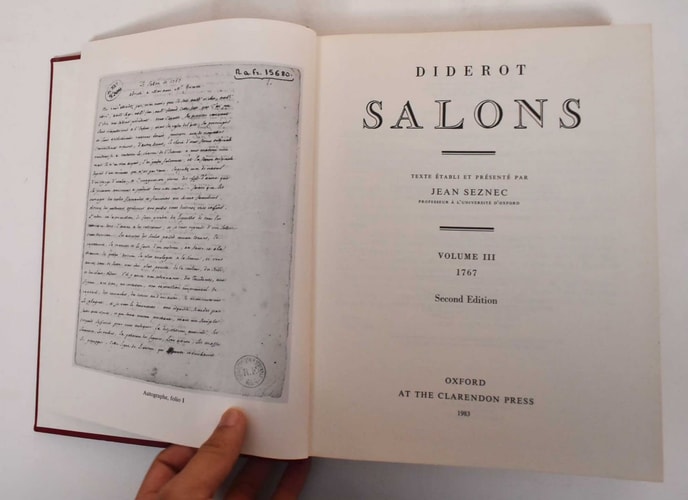
Diderot: Salons, 1767
0
0
As an Amazon Associate and affiliate partner, Menrva Books earns from qualifying purchases. Learn more
Author Description
The eighteenth-century French philosophe Denis Diderot—the principal intelligence behind the Encyclopédie and the author of idiosyncratic fictional works such as Jacques the Fatalist and Rameau's Nephew—was also the first great art critic. Until now, however, Diderot's treatises on the visual arts have been available only in French. This two-volume edition makes the most important of his art-critical texts available in English for the first time.Diderot's works are among the most provocative and engaging products of the French Enlightenment. Moreover, their ruminations on many issues of perennial interest (invention versus convention, nature versus culture, and technique versus imagination; the complex relations between economic reality and artistic achievement) give them a rare pertinence to current debates on the nature and function of representation. All the celebrated pieces are here: the rhapsodic dream meditation inspired by Fragonard's Corésus and Callierhoé; the incident-packed "excursion" through a set of landscapes by Joseph Vernet; the evocative consideration of the nature of ruins and historical nostalgia prompted by the first showing of works by Hubert Robert. But these famous passages can now be considered in their proper context, surrounded by meditations that are less well known but equally sparkling. The book also includes brief introductory texts and annotations by John Goodman that clarify the many references to contemporary Parisian culture, as well as an introduction by Thomas Crow that sets the texts in their historical and art-historical context.
Menrva's Summary
THE THESIS
This collection investigates the foundational role of Denis Diderot as the first significant art critic, examining how his critiques of the 1767 Salon shaped Enlightenment aesthetic theory. Jean Francois Seznec, a scholar of French literature and art, compiles these critical texts to demonstrate how Diderot’s observations on contemporary painting bridged the gap between philosophy and visual representation. By contextualizing these writings within the broader intellectual framework of the eighteenth century, the work argues that Diderot’s subjective, rhapsodic style established a new paradigm for art criticism that remains relevant to modern debates on culture and technique.
THE SCOPE MAP
What You Will Find
- Comprehensive English translations of Diderot’s critical essays from the 1767 Salon.
- Scholarly annotations by John Goodman detailing the nuances of Parisian cultural life.
- Historical contextualization provided by Thomas Crow regarding the evolution of art-critical discourse.
- Analytical discussions on the tension between nature, imagination, and economic reality in artistic production.
THE AUTHORITY PERSPECTIVE
Scholars and art historians regard this edition as a foundational resource for accessing Diderot’s critical output in English. Readers frequently note the academic density of the prose, which is balanced by the inclusion of helpful introductory materials that clarify the historical context for non-specialists.
Page Count:
388
Publication Date:
1983-01-01
Publisher:
Oxford Univ Pr
ISBN-10:
0198173725
ISBN-13:
9780198173724
Biography
Philosophy
Criticism
Art History
French literature
Enlightenment
Community Tags
Similar Books