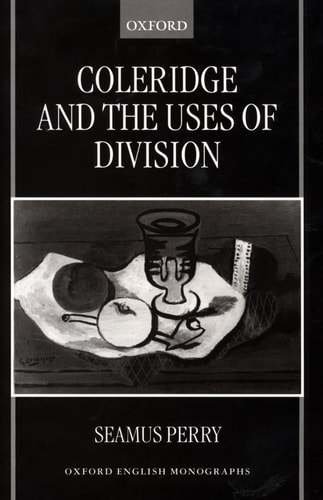
Coleridge and the Uses of Division
0
0
As an Amazon Associate and affiliate partner, Menrva Books earns from qualifying purchases. Learn more
Author Description
Coleridge was a visionary drawn to the numinous, but he was also a spontaneous connoisseur of the sensory life. Such double-mindedness has often been criticized as a sort of incapacity; but the capability of entertaining equally necessary kinds of perception might be thought a kind of virtue. The study examines Coleridge's formative double-vision as it manifests itself in his profound self-analysis, his philosophy of mind, and his literary criticism.
Menrva's Summary
THE THESIS
This study investigates whether Samuel Taylor Coleridge’s characteristic intellectual and psychological division represents a fundamental incapacity or a sophisticated mode of perception. Seamus Perry, a scholar of Romantic literature, argues that Coleridge’s tendency toward double-mindedness is not a failure of focus but a deliberate, albeit complex, engagement with the world. By analyzing Coleridge’s self-reflective writings, philosophical inquiries, and critical essays, Perry demonstrates how this duality informs the poet's unique approach to both sensory experience and abstract thought.
THE SCOPE MAP
What You Will Find
- An analysis of Coleridge’s internal conflict between visionary idealism and sensory observation.
- A critical examination of Coleridge’s philosophy of mind and its application to his literary theory.
- A detailed study of Coleridge’s self-analysis as presented in his notebooks and correspondence.
- An evaluation of how double-vision functions as a structural element in Coleridge’s major poetic and critical works.
THE AUTHORITY PERSPECTIVE
Scholars frequently cite this work as a nuanced intervention in Coleridge studies, particularly for its defense of the poet's intellectual consistency. Readers often note the academic density of the prose, which is intended for those already familiar with the intricacies of Romantic-era philosophy and literary criticism.
Page Count:
320
Publication Date:
1999-11-25
Publisher:
Clarendon Press
ISBN-10:
0198183976
ISBN-13:
9780198183976
Biography
Philosophy
Poetry
Academic
Literary Criticism
Dialectic