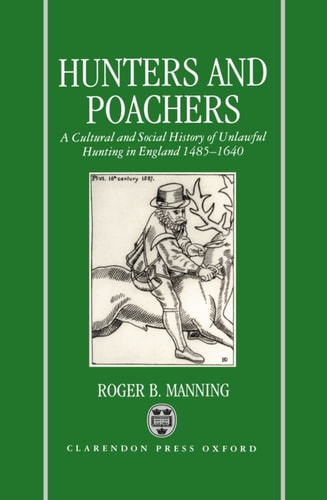
Hunters and Poachers: A Social and Cultural History of Unlawful Hunting in England 1485-1640
0
0
As an Amazon Associate and affiliate partner, Menrva Books earns from qualifying purchases. Learn more
Author Description
Hunting and poaching played significant roles in England during the sixteenth and seventeenth centuries. Deer-hunting was an integral part of the culture of the aristocracy and gentry. It afforded not only recreation, but also served as a symbolic substitute for war and rebellion. During this period, the distinction between lawful and unlawful hunting remained unclear, for the Game Laws were obscure and difficult to enforce. Roger B. Manning's meticulously researched study explores symbolic and covert forms of protest, and adds much to our knowledge of the interaction between aristocratic and popular culture in early modern England.
Menrva's Summary
THE THESIS
This study investigates how the practice of poaching in early modern England functioned as a complex social and cultural expression of protest rather than mere criminal activity. Roger B. Manning, a historian specializing in early modern British social structures, utilizes a wide array of legal records and contemporary accounts to analyze the blurred lines between aristocratic privilege and popular resistance. He argues that the ambiguity of the Game Laws allowed hunting to serve as a symbolic proxy for political rebellion and class conflict between the gentry and the common populace.
THE SCOPE MAP
What You Will Find
- An analysis of the socio-political function of deer-hunting in the sixteenth and seventeenth centuries.
- A detailed examination of the legal framework and enforcement challenges of the English Game Laws.
- Evidence drawn from primary historical documents, including court records and aristocratic correspondence.
- Exploration of the intersection between popular culture and the elite social rituals of the era.
THE AUTHORITY PERSPECTIVE
Historians and scholars of the early modern period frequently cite this work for its detailed archival research and its nuanced interpretation of class-based social tensions. Experts highlight the text as a foundational resource for understanding how legal systems were manipulated to maintain social order during this volatile era.
Page Count:
280
Publication Date:
1993-10-21
Publisher:
Clarendon Press
ISBN-10:
0198203241
ISBN-13:
9780198203247
History
Legal History
Cultural History
Criminology
Great Britain
Poaching
Social History
Game Laws
Community Tags
Similar Books