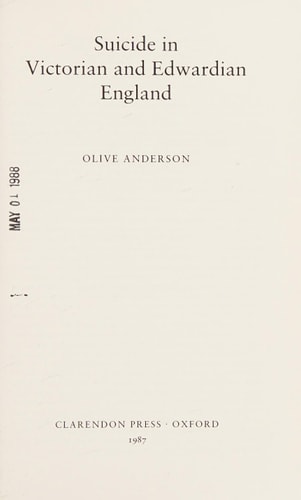
Suicide in Victorian and Edwardian England
0
0
As an Amazon Associate and affiliate partner, Menrva Books earns from qualifying purchases. Learn more
Author Description
The first serious historical study of a central human problem, this book opens new avenues for understanding the nature of--and responses to--suicidal behavior as it charts unexplored terrain in the general history of death. Using an unusual array of historical techniques and sources, including coroners' private case papers, Olive Anderson examines in turn four key elements in the study of suicide: suicide rates and distribution, individual experiences, social attitudes, and efforts at prevention. Her lucid and humane approach to this sensitive subject affords unique perspectives on the significance of time, place, age, and gender; on law, literature, medicine, and collective mentalities; and on the police, philanthropy, and public policy in Victorian and Edwardian England.
Menrva's Summary
THE THESIS
This book investigates the historical evolution of suicidal behavior and societal responses to it within the context of Victorian and Edwardian England. Olive Anderson, a respected historian, utilizes an extensive array of primary sources, including private coroners' case papers, to construct a comprehensive analysis of how self-destruction was perceived and managed during this era. Her work challenges existing historical narratives by integrating legal, medical, and cultural data to map the shifting landscape of death and public policy.
THE SCOPE MAP
What You Will Find
- Statistical analysis of suicide rates and geographic distribution across England.
- Examination of individual case studies derived from private coroners' records.
- Analysis of the intersection between law, medicine, and Victorian social attitudes.
- Evaluation of institutional responses, including police intervention, philanthropy, and public policy.
THE AUTHORITY PERSPECTIVE
Experts recognize this work as a foundational text in the history of death and social behavior, noting its meticulous use of archival evidence. Readers frequently highlight the academic density of the prose, which provides a rigorous and humane examination of a complex historical subject.
Page Count:
494
Publication Date:
1987-10-08
Publisher:
Clarendon Press
ISBN-10:
019820101X
ISBN-13:
9780198201014
History
Sociology
Criminology
Social History
Suicide
Death Studies
Victorian History
Community Tags
Similar Books