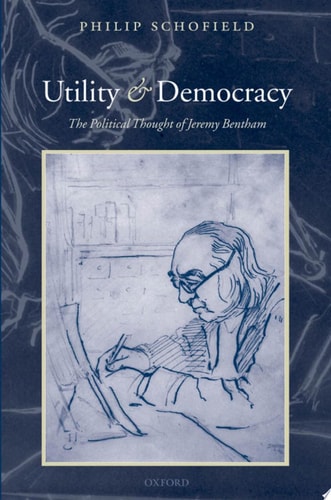
Utility and Democracy: The Political Thought of Jeremy Bentham
0
0
As an Amazon Associate and affiliate partner, Menrva Books earns from qualifying purchases. Learn more
Author Description
Utility and Democracy is the first comprehensive historical account of the political thought of Jeremy Bentham (1748-1832), the philosopher and reformer. Philip Schofield draws on his extensive knowledge of Bentham's unpublished manuscripts and original printed texts, and on the new, authoritative edition of The Collected Works of Jeremy Bentham. A compelling narrative charts the way in which Bentham applied his utilitarian philosophy to the rapidly changing circumstances of his age.Schofield begins with a lucid account of Bentham's insights in the fields of logic and language, and in particular his theory of real and fictitious entities, which lie at the foundation of his thought. He proceeds to show how these insights brought Bentham to the principle of utility, which led him in turn to produce the first systematic defense of democracy from a utilitarian perspective. In contrast to previous scholarship, which claims that Bentham's "conversion" or "transition" to political radicalism took place either at the time of the French Revolution or following his meeting with James Mill in 1808 or 1809, Professor Schofield shows that the process began in or around 1804 when the notion of sinister interest emerged in Bentham's thought. Bentham appreciated that rulers, rather than being motivated by a desire to promote the greatest happiness of those subject to them, aimed to promote their own happiness, whatever the overall cost to the community.In his constitutional writings of the 1820s, which he addressed to "all nations professing liberal opinions," Bentham argued that the proper end of constitutional design was to maximize official aptitude and minimize government expense, and that the publicity of official actions, within the context of a republican system of government where sovereignty lay in the people, was the means to achieve it. Bentham's commitment to radical reform led him to advocate the abolition of the British monarchy and House of Lords, the replacement of
Menrva's Summary
THE THESIS
This work investigates the evolution of Jeremy Bentham's political thought and his transition toward radical democratic theory. Philip Schofield, a leading expert on Bentham, utilizes unpublished manuscripts and the authoritative Collected Works to reconstruct the philosopher's intellectual development. The book argues that Bentham's shift toward radicalism was not a sudden conversion but a logical progression rooted in his theory of 'sinister interest' and his utilitarian application to governance.
THE SCOPE MAP
What You Will Find
- An analysis of Bentham's foundational theories on logic, language, and fictitious entities.
- A detailed timeline of Bentham's political evolution from 1804 through the 1820s.
- Examination of Bentham's constitutional designs for republican government and official accountability.
- A critical reassessment of existing scholarship regarding the timing and motivation behind Bentham's radicalism.
THE AUTHORITY PERSPECTIVE
Scholars recognize this text as a definitive account of Bentham's political philosophy, particularly for its meticulous use of primary source material. Readers frequently note the academic density of the prose, which serves as a foundational resource for students of political history and utilitarian thought.
Page Count:
370
Publication Date:
2006-08-24
Publisher:
Oxford University Press
ISBN-10:
0198208561
ISBN-13:
9780198208563
Philosophy
History
Biography
Political Philosophy
Community Tags
Similar Books