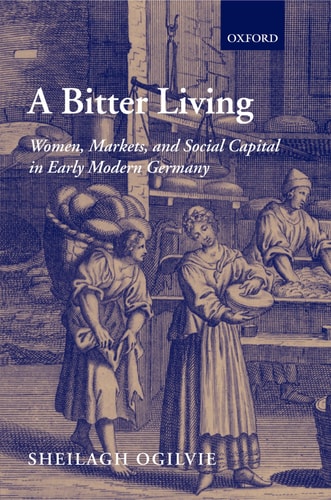
A Bitter Living: Women, Markets, and Social Capital in Early Modern Germany
0
0
As an Amazon Associate and affiliate partner, Menrva Books earns from qualifying purchases. Learn more
Author Description
What role did women play in the pre-industrial European economy? Was it brought about by biology, culture, social institutions, or individual choices? And what were its consequences - for women, for men, for society at large? Women were key to the changes in the European economy between 1600 and 1800 that paved the way for industrialization. But we still know little about this female 'shadow economy' - and nothing quantitative or systematic.This book tackles these questions in a new way. It uses a unique micro-level database and rich qualitative sources to illuminate women's contribution to a particular pre-industrial economy: the German state of Württemberg, which was in many ways typical of early modern Europe. Markets expanded here between 1600 and 1800, opening opportunities outside the household for both women and men. But they were circumscribed by strong 'social networks' - local communities and rural guilds with state support. Modern political scientists have praised social networks for generating 'social capital' - shared norms and collective sanctions which benefit network insiders, and sometimes the whole society. But this book reveals the dark side of 'social capital': insiders excluded and harmed outsiders, especially women, to the detriment of the economy at large.Early modern European economies differed widely in their restrictions on the role of women. But the monocausal approaches (technological, cultural, institutional) that dominate the existing literature cannot explain these differences. This book proposes an alternative approach driven by the decision individual women themselves made as they negotiated a wide array of constraints and pressures (including technological, cultural, and institutional ones). We are not only brought closer to the 'bitter living' pre-industrial women scraped together, but find out how it came to be so bitter, and how restrictions on women inflicted a bitter living on everyone.
Menrva's Summary
THE THESIS
This book investigates how social institutions and networks in early modern Germany constrained women's economic participation and hindered broader economic development. Sheilagh Ogilvie, a professor of economic history, utilizes a unique micro-level database from the German state of Württemberg between 1600 and 1800 to challenge existing monocausal theories regarding pre-industrial economic growth. By analyzing the interplay between individual agency and institutional barriers, she argues that the 'social capital' generated by local communities and guilds often functioned as a mechanism for exclusion that ultimately stifled economic potential for both women and the wider society.
THE SCOPE MAP
What You Will Find
- Quantitative and qualitative analysis of the Württemberg economy from 1600 to 1800.
- Examination of the role of rural guilds and local community networks in regulating labor.
- A critique of the 'social capital' framework as applied to historical institutional exclusion.
- Evidence regarding the impact of gender-based restrictions on pre-industrial market expansion.
THE AUTHORITY PERSPECTIVE
Historians and economists recognize this work as a rigorous challenge to conventional institutional theories regarding pre-industrial development. Scholars frequently highlight the depth of the archival research and the author's ability to synthesize micro-level data into a broader economic argument.
Page Count:
416
Publication Date:
2003-08-07
Publisher:
Oxford University Press
ISBN-10:
0198205546
ISBN-13:
9780198205548
Economics
History
Germany economic conditions
European History
Women germany
Gender Studies
Germany
Sociology
Community Tags
Similar Books