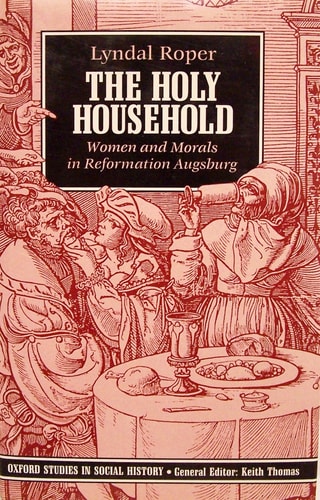
The Holy Household: Women and Morals in Reformation Augsburg
0
0
As an Amazon Associate and affiliate partner, Menrva Books earns from qualifying purchases. Learn more
Author Description
This is a fascinating study of the impact of the Reformation idea of "civic righteousness" on the position of women in Augsburg. Roper argues that its development, both as a religious credo and as a social movement, must be understood in terms of gender. Until now the effects of the Reformation on women have been viewed as largely beneficial--Protestantism being linked with the forces of progressivism, individualism, and modernization. Roper here argues that such a view of the Reformation's legacy is a profound misreading, and that the status of women was, in fact, worsened by the Reformation. A number of themes are explored: the economic position of women in the household economy; the nature of "civic righteousness" and how it applied a "reform moralism" to the role of marriage and the household; the efforts of civic authority to reform sexual deviance; the attempts to control marriage and the breakdown of marriage; and the role of convents and nuns. The Holy Household is the first scholarly account of how the Reformation affected half of society. It combines sound application of feminist theory with careful, open-ended archival research to advance our understanding of the Reformation, of feminist history, and of the place of women in modern European society.
Menrva's Summary
THE THESIS
This study investigates how the Reformation's concept of civic righteousness fundamentally altered the social and economic status of women in sixteenth-century Augsburg. Lyndal Roper, a historian specializing in early modern Europe, utilizes extensive archival research to challenge the prevailing narrative that the Reformation was an inherently progressive force for women. By applying a gender-focused analytical framework, she argues that the movement actually institutionalized patriarchal control and diminished the autonomy women previously held within the household economy.
THE SCOPE MAP
What You Will Find
- Analysis of the economic role of women within the urban household economy of Augsburg.
- Examination of civic authority efforts to regulate sexual behavior and marriage stability.
- Investigation into the dissolution of convents and the subsequent impact on the lives of nuns.
- Application of feminist theory to primary source archival data regarding Reformation moralism.
THE AUTHORITY PERSPECTIVE
Historians and scholars of the Reformation frequently cite this work as a foundational text for understanding the intersection of gender and religious reform. Readers often note the academic density of the prose and the rigorous, evidence-based approach to challenging traditional historiography.
Page Count:
310
Publication Date:
1990-01-04
Publisher:
Oxford University Press
ISBN-10:
0198217692
ISBN-13:
9780198217695
History
Gender Studies
European History
Reformation
Women
Women germany
Social History
Religious Life
Community Tags
Similar Books