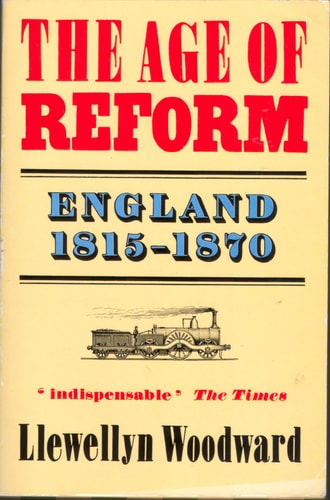
The Age of Reform: 1815-1870
0
0
As an Amazon Associate and affiliate partner, Menrva Books earns from qualifying purchases. Learn more
Author Description
Between Waterloo and Gladstone's first ministry, Britain underwent a series of rapid and complex changes. At home, repression gave way to reform of the franchise, local government, education, poor relief, and the factory and legal systems. Further agitation arose in the 1840s over the Corn Laws, the People's Charter, and the Irish Question. By the 1860s, Britain was able to bask in the glow of the mid-Victorian supremacy forged by its economic might and the foreign policy pursued by Castlereagh, Canning, and Palmerston, which maintained the balance of power and extended the colonial empire. Authoritative and incisive, this newly paperbacked volume in the Oxford History of England is a classic study of Britain in the ascendant.
Menrva's Summary
THE THESIS
How did the British state navigate the transition from post-Napoleonic repression to the mid-Victorian era of economic and colonial supremacy? Sir Llewellyn Woodward, a distinguished historian, examines the structural evolution of Britain between 1815 and 1870. By analyzing legislative reforms, economic shifts, and diplomatic maneuvers, he argues that this period defined the modern British state through a series of incremental yet profound institutional adjustments.
THE SCOPE MAP
What You Will Find
- Comprehensive analysis of the legislative reforms concerning the franchise, education, and poor relief.
- Examination of the political impact of the Corn Laws and the People's Charter.
- Evaluation of British foreign policy under Castlereagh, Canning, and Palmerston.
- Historical overview of the expansion of the British colonial empire during the mid-Victorian era.
THE AUTHORITY PERSPECTIVE
Experts recognize this work as a foundational text within the Oxford History of England series, valued for its incisive analysis of 19th-century governance. Readers frequently note the academic density of the prose, which provides a rigorous and detailed account of the era's complex political landscape.
Page Count:
702
Publication Date:
1985-01-01
Publisher:
Oxford University Press
ISBN-10:
0198217110
ISBN-13:
9780198217114
History
Social History
Great Britain
19th Century
British History
Political History
Community Tags
Similar Books