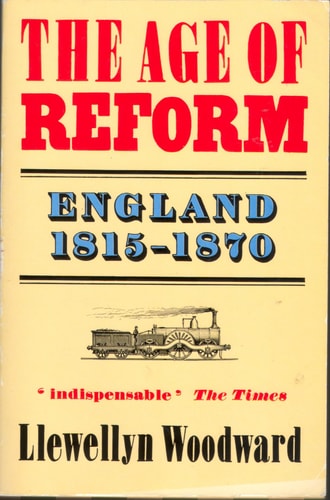
The Age of Reform 1815-1870
0
0
As an Amazon Associate and affiliate partner, Menrva Books earns from qualifying purchases. Learn more
Author Description
Between Waterloo and Gladstone's first ministry, Britain underwent a series of rapid and complex changes. At home, repression gave way to reform of the franchise, local government, education, poor relief, and the factory and legal systems. Further agitation arose in the 1840s over the Corn Laws, the People's Charter, and the Irish Question. By the 1860s, Britain was able to bask in the glow of the mid-Victorian supremacy forged by its economic might and the foreign policy pursued by Castlereagh, Canning, and Palmerston, which maintained the balance of power and extended the colonial empire.
Menrva's Summary
THE THESIS
This volume investigates the rapid political, social, and economic transformation of Britain during the period between the Battle of Waterloo and the first ministry of William Gladstone. Sir Llewellyn Woodward, a distinguished historian, utilizes a wealth of archival data and parliamentary records to construct a comprehensive narrative of the era. The work argues that the transition from post-war repression to mid-Victorian supremacy was driven by systematic legislative reform and a calculated foreign policy that secured Britain's global influence.
THE SCOPE MAP
What You Will Find
- Detailed analysis of the reform of the franchise, local government, and the poor relief system.
- Examination of the political impact of the Corn Laws and the People's Charter.
- Overview of British foreign policy under figures such as Castlereagh, Canning, and Palmerston.
Scope Limits
- The text focuses primarily on political and institutional history rather than detailed cultural or artistic developments of the Victorian era.
THE AUTHORITY PERSPECTIVE
Historians and scholars frequently cite this work as a foundational text for understanding the legislative evolution of 19th-century Britain. Readers often note the academic density of the prose, which provides a rigorous and authoritative account of the period's complex administrative changes.
Page Count:
720
Publication Date:
1996-01-04
Publisher:
Oxford University Press
ISBN-10:
0192852620
ISBN-13:
9780192852625
History
Political History
British History
Social History
19th Century
Community Tags
Similar Books