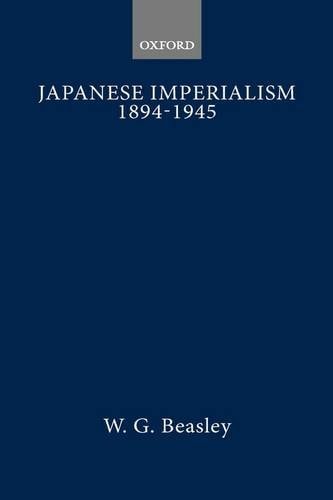
Japanese Imperialism: 1894-1945
0
0
As an Amazon Associate and affiliate partner, Menrva Books earns from qualifying purchases. Learn more
Author Description
Studying the development, expansion, and eventual collapse of Japanese imperialism from the Sino-Japanese war of 1894-1895 through 1945, Beasley here discusses the dynamic relationship between a successful industrial economy and the building of an empire. The only country in Asia to build such a strong political and economic foundation in modern times, the Japanese empire has become known as one of the most remarkable exploits of the 20th century.
Menrva's Summary
THE THESIS
How did Japan successfully construct and sustain a modern imperial power while simultaneously developing a robust industrial economy between 1894 and 1945? W. G. Beasley, a prominent historian of Japan, utilizes a comprehensive historical framework to examine the intersection of economic modernization and territorial expansion. By analyzing the political and social mechanisms that facilitated Japan's rise, the author argues that the empire was not merely a military project but a complex byproduct of industrial growth and national ambition. The text provides a detailed account of the internal and external pressures that shaped Japan's trajectory from the Sino-Japanese War to the conclusion of the Second World War.
THE SCOPE MAP
What You Will Find
- Analysis of the Sino-Japanese War and its role in initiating imperial expansion.
- Examination of the symbiotic relationship between industrialization and state-building.
- Historical assessment of the collapse of the Japanese empire in 1945.
- Evaluation of the political foundations that allowed Japan to become a dominant Asian power.
THE AUTHORITY PERSPECTIVE
Historians frequently cite this work as a foundational text for understanding the structural evolution of the Japanese empire. Readers often note the academic density of the prose, which provides a rigorous and thorough examination of the period for students and scholars alike.
Page Count:
280
Publication Date:
1987-05-21
Publisher:
Oxford University Press
ISBN-10:
0198215754
ISBN-13:
9780198215752
History
Imperialism
Asian History
Japan
Japanese History
Economic History
Community Tags
Similar Books