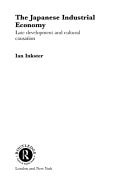
Japanese Industrial Economy
0
0
As an Amazon Associate and affiliate partner, Menrva Books earns from qualifying purchases. Learn more
Author Description
This book reveals that the manipulation of culture was of more importance than the character of the original cultural stock in explaining Japan's modern industrialization. Thus the features of private enterprise culture that are so often isolated as keys to the nation's historical competitiveness may have been only temporary reflections of this wider process of cultural engineering: a necessary input into the program of technology transfer and late development. This book provides a highly reliable guide to the industrial economy and history and covers a wide ground; it will be of great interest to those involved in Asian studies, Japanese studies, plus economists and professionals in business and enterprise culture.
Menrva's Summary
THE THESIS
This book investigates whether the manipulation of culture, rather than inherent cultural traits, served as the primary driver for Japan's modern industrialization. Ian Inkster, an established scholar in economic history, challenges the conventional view that Japan's historical competitiveness stemmed from fixed cultural characteristics. By analyzing the intersection of technology transfer and state-led development, he argues that what is often perceived as a static 'private enterprise culture' was actually a product of deliberate cultural engineering designed to facilitate rapid modernization.
THE SCOPE MAP
What You Will Find
- Analysis of the relationship between technology transfer and late-stage industrial development.
- Examination of cultural engineering as a strategic input for economic growth.
- Historical assessment of private enterprise culture in the Japanese context.
- Comparative insights into the mechanisms of national competitiveness.
THE AUTHORITY PERSPECTIVE
Experts recognize this work as a significant contribution to the study of Japanese economic history and the sociology of development. Readers frequently note the academic density of the prose, which provides a rigorous framework for understanding the complexities of industrial policy and cultural adaptation.
Page Count:
176
Publication Date:
2012-01-01
Publisher:
Taylor & Francis Group
ISBN-10:
0203472047
ISBN-13:
9780203472040
Business
History
Economics
Japan
Asian Studies
Economic History