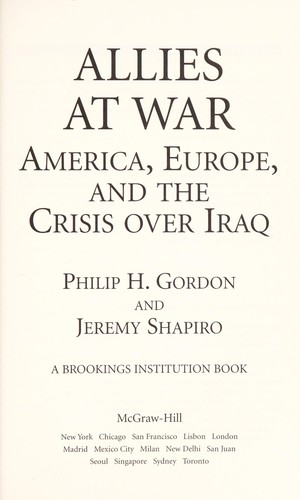
Allies at War
0
0
As an Amazon Associate and affiliate partner, Menrva Books earns from qualifying purchases. Learn more
Author Description
From the 1956 Suez Crisis to the disputes over US military intervention in Bosnia and Kosovo in the 1990s, the history of the post-World War II American-European alliance is one of nearly continuous diplomatic crisis. Yet, no matter how deep the divisions or bitter that dispute, in the end, the allies always found ways to rise above their differences and preserve the integrity of an alliance that, by the late 1990s, had become the most successful in world history. The diplomatic wrangling over the war in Iraq produced the worst transatlantic crisis in nearly fifth years, and for the first time leaders in both the United States and Europe are seriously questioning the viability and, indeed, even the value of the alliance. But is this latest crisis really so different from all those that came before it? Is it, as some contend, the culmination of an inevitable process of dissolution that began with the end of the Cold War and become clear after 9/11? Is the fragile US-European alliance and the world order it supports coming unraveled? In Allies at War, distinguished Brookings analysts Philip Gordon and Jeremy Shapiro provide answers to these and other critical questions about the current crisis in US-European relations and its implications for the future. To help put the current crisis into context the authors trace the evolution of American-European relations since World War II. They describe how deep ideological differences that emerged at the end of the Cold War and disputes over the Balkans, Iran, and Iraq during the Clinton years already had some analysts questioning if the alliance would survive. They explain how the Bush administration's "cowboy diplomacy" helped bring already simmering tensions to a boil. And they provide a detailed, inside account of the events leading up to the Iraq crisis, describing how a series of disastrous diplomatic missteps turned a legitimate disagreement over how to deal with a rogue regime into a crisis that threatened the al
Menrva's Summary
THE THESIS
This book investigates the historical trajectory and current fragility of the post-World War II American-European alliance, particularly in the wake of the 2003 Iraq War. The authors, Philip Gordon and Jeremy Shapiro, analyze the persistent diplomatic crises that have characterized the alliance since the 1956 Suez Crisis, examining how, despite deep divisions, allies have historically found ways to preserve their union. The work specifically addresses whether the Iraq War crisis is fundamentally different from past disputes, questioning if it signals an inevitable dissolution following the Cold War and 9/11, and exploring the implications of this potential unraveling for the world order.
THE SCOPE MAP
- What You Will Find:
- Analysis of American-European relations from the 1956 Suez Crisis to the 1990s Balkans conflicts.
- Examination of the diplomatic crisis precipitated by the 2003 Iraq War and its impact on the alliance.
- Discussion of the ideological differences and disputes that emerged after the Cold War.
- Exploration of the Bush administration's foreign policy and its effect on transatlantic tensions.
- An inside account of the events leading up to the Iraq crisis, detailing diplomatic missteps.
- Assessment of the alliance's viability and value in the face of contemporary challenges.
THE AUTHORITY PERSPECTIVE
In 'Allies at War,' Philip Gordon and Jeremy Shapiro, distinguished Brookings analysts, offer a contextualized examination of the US-European alliance's historical challenges and its critical state in the early 2000s. The authors trace the evolution of transatlantic relations, highlighting how ideological rifts and specific international disputes, such as those over the Balkans, Iran, and Iraq, had already strained the alliance prior to the Bush administration's tenure. The book provides an in-depth look at the diplomatic maneuvering surrounding the Iraq War, arguing that missteps exacerbated existing tensions to a critical point. The work aims to answer whether this crisis is a unique threat to the alliance's survival or a continuation of historical patterns.
Page Count:
268
Publication Date:
2004-01-01
ISBN-10:
0071441204
ISBN-13:
9780071441209
History
Non-Fiction
Politics
International relations
Community Tags
Similar Books