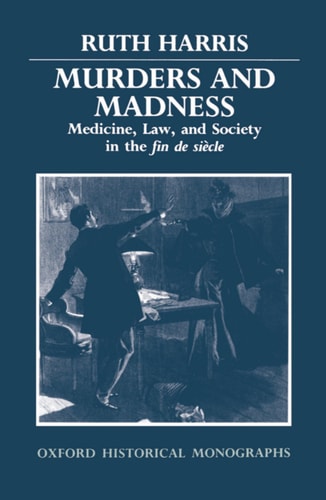
Murders and Madness: Medicine, Law, and Society in the Fin de Siècle
0
0
As an Amazon Associate and affiliate partner, Menrva Books earns from qualifying purchases. Learn more
Author Description
This is an interdisciplinary study of the debate on crime and madness in France between 1880 and 1914. Harris argues that the traditional bases of the French penal system were undermined at the time by psychiatric theories of human behavior and new sociological interpretations of crime, which challenged legal concepts of free will and moral responsibility. The book also examines the evolution of a new kind of knowledge, and shows how the politique criminelle envisaged by specialists was the result of the interaction among the bureaucratic culture of the magistrates, the clinical and scientific world of the psychiatrists, and the background of the defendants.
Menrva's Summary
THE THESIS
This study investigates how the intersection of psychiatric theory and sociological interpretation destabilized the French penal system's traditional reliance on free will and moral responsibility between 1880 and 1914. Ruth Harris, a historian specializing in French social and cultural history, utilizes extensive archival research to analyze the shifting landscape of criminal justice during the fin de siècle. She argues that the emergence of new scientific knowledge forced a confrontation between the bureaucratic rigidity of the judiciary and the clinical observations of medical professionals. By examining the interaction between these disparate institutional cultures, the work illustrates how the definition of criminal culpability was fundamentally transformed.
THE SCOPE MAP
What You Will Find
- Analysis of the French penal system and legal reforms between 1880 and 1914.
- Examination of the tension between psychiatric theories of behavior and traditional legal concepts of free will.
- Investigation into the bureaucratic culture of magistrates and the clinical practices of contemporary psychiatrists.
- Case studies illustrating the social and medical backgrounds of defendants in the fin de siècle period.
THE AUTHORITY PERSPECTIVE
Experts recognize this work as a foundational text for understanding the historical development of forensic psychiatry and criminal law in France. Readers frequently note the academic density of the prose and the meticulous archival detail provided by the author.
Page Count:
376
Publication Date:
1989-09-28
Publisher:
Clarendon Press
ISBN-10:
0198229917
ISBN-13:
9780198229919
History
Criminology
Law
Insanity Law
European History
Sociology
Medicine
Community Tags
Similar Books