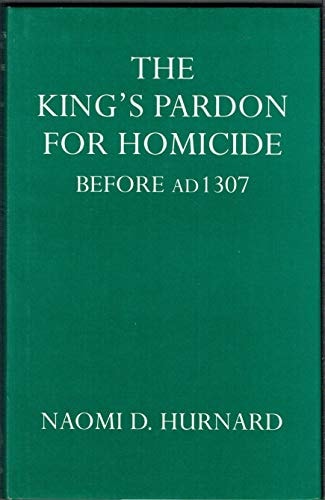
The King's Pardon for Homicide before A.D. 1307
0
0
As an Amazon Associate and affiliate partner, Menrva Books earns from qualifying purchases. Learn more
Author Description
This study seeks to explain why the man who committed homicide by misadventure or in self-defence needed a pardon. It examines the working of the system of pardoning in England in the thirteenth century, its effects on the claims of the victims' kinsmen to secure reparation or bring down retribution on the slayers, and the risk to public order from the king's clemency to those who had killed feloniously. It traces the development of inquisitions into alleged excuses, and an appendix deals with the closely related history of the writ de odio et atia.
Menrva's Summary
THE THESIS
This study investigates the legal and social necessity of the royal pardon for homicide in thirteenth-century England, specifically addressing why individuals who killed by misadventure or in self-defense required formal absolution. Naomi D. Hurnard, a noted medievalist, utilizes extensive archival records and legal documents to analyze the intersection of royal prerogative and common law. The work argues that the pardon system served as a critical mechanism for managing the tension between the king's clemency and the rights of victims' families to seek retribution. By examining the evolution of inquisitions into homicide, Hurnard provides a framework for understanding the administration of justice during this period.
THE SCOPE MAP
What You Will Find
- Analysis of the thirteenth-century English legal system regarding homicide and royal pardons.
- Examination of the writ de odio et atia and its historical development.
- Investigation into the conflict between royal clemency and the claims of victims' kinsmen for reparation.
- Evaluation of the risks posed to public order by the frequent granting of pardons to those who committed felonious acts.
THE AUTHORITY PERSPECTIVE
Historians and legal scholars frequently cite this work as a foundational text for understanding the complexities of medieval English criminal law. Experts highlight the meticulous archival research and the clarity with which Hurnard navigates the dense procedural history of the period.
Page Count:
394
Publication Date:
1997-01-01
Publisher:
Clarendon Press 1925.
ISBN-10:
0198223129
ISBN-13:
9780198223122
History
Criminology
Legal History
English History
Europe
Community Tags
Similar Books