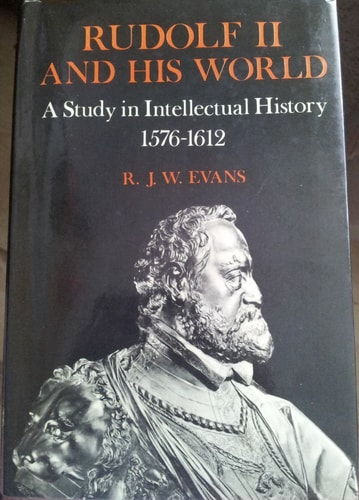
Rudolf II and His World: A Study in Intellectual History, 1576-1612
0
0
As an Amazon Associate and affiliate partner, Menrva Books earns from qualifying purchases. Learn more
Author Description
Rudolf II of Hapsburg, Holy Roman Emperor, King of Bohemia and Hungary, was an extraordinary ruler, a monarch whose court occupied a central position in 16th-century Europe - yet he remained a shadowy and fugitive figure. The decades around 1600 saw sweeping cultural changes in Europe, with the waning of an old-world view and the beginnings of the 17th-century intellectual revolution. The author argues that the conflict which played itself out in the Hapsburg lands during these years was a political manifestation of the intellectual confrontation between the old guard and and their preoccupation with the mystical, spiritual and hermetic sciences, and the rise of a more rational and empirical view of the world. Rudolf, as the embodiment of the old philosophy, failed to grasp this profound shift in the prevailing climate of Professor Evans argues that it was this failure which led to his eventual tragic downfall.
Menrva's Summary
THE THESIS
This work investigates how the reign of Holy Roman Emperor Rudolf II served as a critical nexus for the intellectual and political transition from Renaissance mysticism to the early modern scientific revolution. Robert John Weston Evans, a distinguished historian of Central Europe, utilizes extensive archival research and cultural analysis to argue that Rudolf II’s court functioned as a microcosm of the broader European struggle between hermetic traditions and emerging empirical rationalism. The author posits that the Emperor’s inability to reconcile these conflicting worldviews directly precipitated his political decline and the destabilization of the Hapsburg lands.
THE SCOPE MAP
What You Will Find
- A detailed examination of the Hapsburg court in Prague between 1576 and 1612.
- Analysis of the influence of hermeticism, alchemy, and occult sciences on 16th-century political governance.
- A study of the intellectual shift from late-Renaissance spiritualism to early-modern rationalism.
- Primary source evidence documenting the cultural and religious tensions within the Holy Roman Empire.
THE AUTHORITY PERSPECTIVE
Historians and scholars of the early modern period frequently cite this work as a foundational text for understanding the intellectual climate of the late Hapsburg era. Readers often note the academic density of the prose, which provides a rigorous and comprehensive analysis of the period's complex philosophical landscape.
Page Count:
323
Publication Date:
1973-01-01
Publisher:
Oxford Univ Pr
ISBN-10:
0198225164
ISBN-13:
9780198225164
History
Biography
Political History
Europe
European History
Intellectual History
Renaissance
Educational Resources
Community Tags
Similar Books