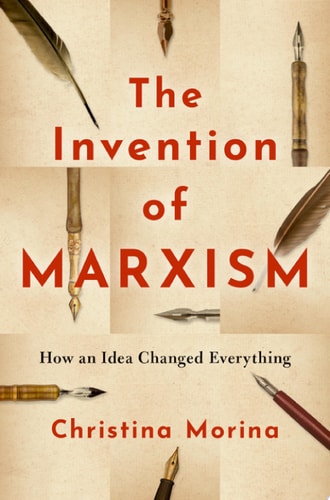
The Invention of Marxism: How an Idea Changed Everything
0
0
As an Amazon Associate and affiliate partner, Menrva Books earns from qualifying purchases. Learn more
Author Description
How did one man's critique of capitalism guide the course of modern history?When he died in 1883, Karl Marx left behind an intellectual legacy of formidable proportions and revolutionary potential, yet one that exerted limited actual political, social, or economic influence. The full force of his ideas did not come into play for another generation, and only after they had been appropriated and applied by some of Marxism's earliest proponents. The history of Marxism, in other words, is the story of those who brought Marx's ideas into play, transforming a sweeping but fractious and occasionally abstruse view of historical and social forces into a coherent plan of action. Christina Morina's illuminating book focuses on the first generation of Marxists who turned the work and ideas of one social theorist, one among many, into one of the most powerful transnational political movements in modern history.The Invention Of Marxism is therefore a group portrait, featuring such figures as Rosa Luxemburg, Max Adler, Jean Jaurès, Eduard Bernstein, Karl Kautsky, and Vladimir Lenin--German, French, Russian, Czech--whose lives became dedicated to interpreting and applying Marxist thought. They were the vehicles by which his ideas were read, debated, and gradually adopted in socialist movements across Europe. Morina's fascinating book therefore reconstructs the beginnings of Marxism through the individual politicization of a group of intellectuals who made it their purpose in life to solve the “social question,” exploring the nexus between their intellectual constructs and social and political reality. The Invention of Marxism shows how what started as a theory of capitalism grew into a fully-fledged political philosophy and platform, one that shaped the century that followed Marx's death. In short, it reveals how an idea first conquered these individuals and then the world.
Menrva's Summary
THE THESIS
This work investigates how the intellectual legacy of Karl Marx was transformed by his early followers into a coherent, transnational political movement that defined the twentieth century. Christina Morina, a historian specializing in modern European history, utilizes biographical analysis and archival research to examine the first generation of Marxist thinkers. She argues that the transition from Marx's abstract theories to a functional political platform was not inevitable, but rather the result of specific intellectual labor performed by figures such as Rosa Luxemburg, Eduard Bernstein, and Vladimir Lenin.
THE SCOPE MAP
What You Will Find
- A collective biography of early Marxist intellectuals including Rosa Luxemburg, Max Adler, Jean Jaurès, Eduard Bernstein, Karl Kautsky, and Vladimir Lenin.
- An analysis of the intellectual process of interpreting and applying Marxist theory to the 'social question' in late nineteenth and early twentieth-century Europe.
- A study of the nexus between abstract political philosophy and the practical realities of socialist movements.
Scope Limits
- The book does not provide a comprehensive history of Marxism throughout the entire twentieth century, focusing instead on the formative period following Marx's death.
- It does not offer a detailed economic critique of Marxist theory itself, prioritizing the history of its political application.
THE AUTHORITY PERSPECTIVE
Scholars and historians frequently commend this work for its rigorous focus on the intellectual origins of political movements rather than just the outcomes. Readers often note the academic density of the prose, which provides a detailed look at the specific individuals responsible for the institutionalization of Marxist thought.
Page Count:
560
Publication Date:
2023-01-12
Publisher:
Oxford University Press
ISBN-10:
0190062738
ISBN-13:
9780190062736
Politics
History
Politics & Government
Women in History
Economics
Economic Policy & Development
Cultural
World politics
European History
Educational Resources
Europe
Anthropology
Women and socialism
New Used & Rental Textbooks
Public Policy
Socialism
World
General
Social History
Intellectual History
20th Century
Marxism
Community Tags
Similar Books