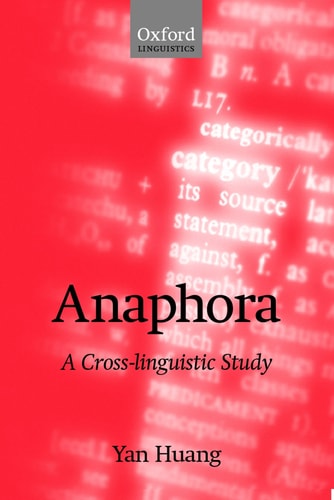
Anaphora: A Cross-Linguistic Study
0
0
As an Amazon Associate and affiliate partner, Menrva Books earns from qualifying purchases. Learn more
Author Description
Understanding any communication depends on the listener or reader recognizing that some words refer to what has already been said or written (his, its, he, there, etc.). This mode of reference, anaphora, involves complicated cognitive and syntactic processes, which people usually perform unerringly, but which present formidable problems for the linguist and cognitive scientist trying to explain precisely how comprehension is achieved.Yan Huang provides an extensive and accessible overview of the major contemporary issues surrounding anaphora and gives a critical survey of the many and diverse contemporary approaches to it. He provides by far the fullest cross-linguistic account yet published: Dr Huang's survey and analysis are based on a rich collection of data drawn from around 450 of the world's languages.
Menrva's Summary
THE THESIS
This book investigates the complex cognitive and syntactic mechanisms that allow humans to interpret anaphoric references in communication. Yan Huang, a specialist in linguistics, synthesizes contemporary research to address how listeners and readers successfully resolve references like pronouns and spatial markers. By examining a vast array of linguistic data, the author constructs a framework for understanding the intersection of grammar, pragmatics, and cognitive processing.
THE SCOPE MAP
What You Will Find
- A cross-linguistic analysis of anaphora across approximately 450 distinct languages.
- A critical evaluation of current theoretical approaches to reference resolution.
- Examination of the cognitive and syntactic processes involved in comprehension.
- A comprehensive survey of major contemporary issues in linguistic typology.
THE AUTHORITY PERSPECTIVE
Experts recognize this work as a foundational text for its extensive data collection and comparative methodology. Scholars frequently cite the book for its clarity in navigating complex theoretical debates within the field of linguistics.
Page Count:
416
Publication Date:
2000-11-09
Publisher:
Oxford University Press
ISBN-10:
0198235283
ISBN-13:
9780198235286
Reference
Academic
Linguistics
Community Tags
Similar Books