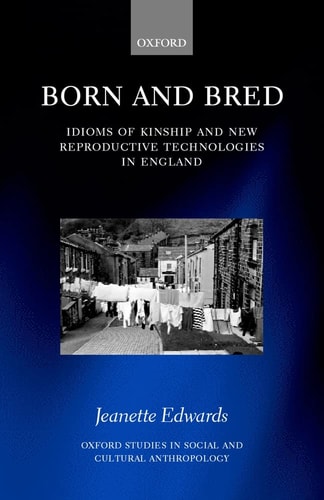
Born and Bred: Idioms of Kinship and New Reproductive Technologies in England
0
0
As an Amazon Associate and affiliate partner, Menrva Books earns from qualifying purchases. Learn more
Author Description
Born and Bred is an ethnography of Bacup in the north-west of England. At the heart of the cotton industry in the nineteenth century, this Lancashire town has undergone deep social and economic change during the twentieth, yet it remains a hive of social activity. The book focuses on the way in which the past continues to figure in people's talk about the place and about each other, but it questions the claim that such a preoccupation is simply due to nostalgia for better times. Narratives about the past, like narratives about the kind of place Bacup is, mobilize cultural understandings of kinship, which are also deployed when people talk about the implications of new reproductive technologies. Jeanette Edwards argues that kinship is resonant in the way in which residents of the town belong to pasts, places and persons. She challenges the idea that kinship is no longer an organizing principle in post-industrial Western society.
Menrva's Summary
THE THESIS
This work investigates how traditional concepts of kinship persist as an organizing principle in post-industrial English society, specifically in the context of modern reproductive technologies. Jeanette Edwards, an anthropologist, utilizes extensive ethnographic fieldwork conducted in the Lancashire town of Bacup to examine how residents conceptualize belonging, history, and biological connection. She argues that local narratives about the past and place are not merely nostalgic, but are active frameworks used to interpret and navigate the implications of new reproductive science.
THE SCOPE MAP
What You Will Find
- Ethnographic study of the town of Bacup, Lancashire, focusing on social and economic transitions.
- Analysis of how kinship terminology and concepts are applied to modern reproductive technologies.
- Examination of the relationship between local identity, historical memory, and social belonging.
- Qualitative data derived from resident narratives, interviews, and observations of social interaction.
THE AUTHORITY PERSPECTIVE
Scholars in the field of social anthropology frequently cite this work as a foundational text for understanding the intersection of kinship studies and medical technology. Experts highlight the author's ability to bridge the gap between local community identity and broader societal shifts in reproductive ethics.
Page Count:
280
Publication Date:
2000-06-01
Publisher:
Oxford University Press
ISBN-10:
0198233949
ISBN-13:
9780198233947
Ethnography
Anthropology
Reproductive Technology
Sociology
Community Tags
Similar Books