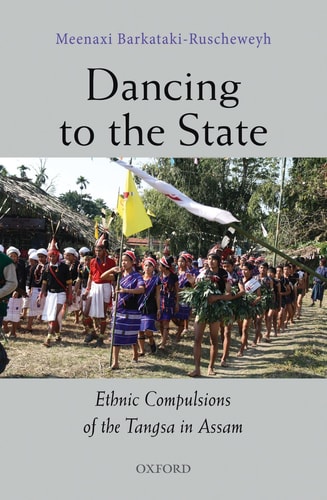
Dancing to the State: The Ethnic Compulsions of the Tangsa in Assam
0
0
As an Amazon Associate and affiliate partner, Menrva Books earns from qualifying purchases. Learn more
Author Description
Can small indigenous communities survive, as distinct cultural entities, in northeast India, an area of mindboggling ethnic, linguistic and cultural diversity? What are the choices such communities have, and what are some of the strategies such communities use to resist marginalisation? In recent years, many such small groups are participating in large state sponsored ethnic festivals, and organising their own community festivals. But are these signs of their increasing agency or simply proof of their continued marginalisation? How do state policies and political borders -- inter-state as well as international -- impact on a community's need to perform their ethnicity? These are some of the questions that will be addressed in this work, on the basis of ethnographic field work conducted among the small Tangsa community living in Assam in northeast India. The study also reveals the asymmetry in the relations between the dominant power-wielding Assamese and the Tangsa. In summary, this is a study about marginality and its consequences, about performance of ethnicity at festivals as sites for both resistance and capitulation, and about the compulsions, imposed by the state and dominant neighbours, that can force small ethnic groups to contribute to their own marginalisation.
Menrva's Summary
THE THESIS
This work investigates how small indigenous communities in northeast India navigate the tension between maintaining cultural distinctiveness and responding to the pressures of state-sponsored marginalization. Author Meenaxi Barkataki-Ruscheweyh utilizes extensive ethnographic fieldwork conducted among the Tangsa people of Assam to analyze the complex dynamics of ethnic performance. The study argues that participation in festivals serves as a dual-purpose site where communities simultaneously resist erasure and inadvertently capitulate to the demands of dominant power structures.
THE SCOPE MAP
What You Will Find
- Analysis of the Tangsa community's social and cultural practices within the Assam region.
- Examination of state-sponsored ethnic festivals as political instruments.
- Qualitative data derived from long-term ethnographic field research.
- Theoretical framework regarding the asymmetry of power between minority groups and dominant regional populations.
THE AUTHORITY PERSPECTIVE
Scholars in the field of South Asian anthropology recognize this text as a significant contribution to the study of ethnic identity and state relations. Readers frequently note the academic rigor of the prose and the depth of the author's engagement with the specific political challenges faced by marginalized groups in northeast India.
Page Count:
384
Publication Date:
2017-08-29
Publisher:
Oxford University Press
ISBN-10:
0199472599
ISBN-13:
9780199472598
India
Sociology
Anthropology
Ethnography
Festivals
Community Tags
Similar Books