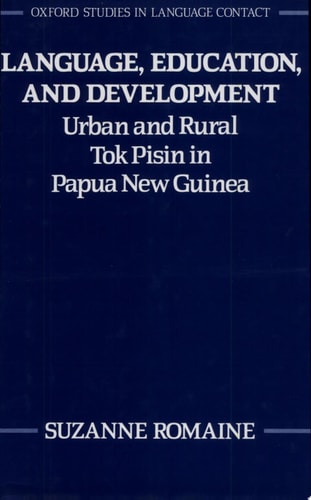
Language, Education, and Development: Urban and Rural Tok Pisin in Papua New Guinea
0
0
As an Amazon Associate and affiliate partner, Menrva Books earns from qualifying purchases. Learn more
Author Description
Papua New Guinea's struggle for development is intimately bound up with the history of Tok Pisin, an English-based pidgin that is the product of nineteenth-century colonialism in the Pacific. The language has since become the most important lingua franca in the region, being spoken by more than a million people in a highly multilingual society. In this book, Romaine examines some of the changes that are taking place in Tok Pisin as it becomes the native language of the younger generation of rural and urban speakers. These linguistic processes, which are by no means complete, have to be understood in the socio-historical context of colonial expansion and strategies for socio-economic development in the post-colonial era.
Menrva's Summary
THE THESIS
This book investigates how the evolution of Tok Pisin from a colonial pidgin to a native language reflects broader socio-economic development challenges in Papua New Guinea. Suzanne Romaine, a prominent sociolinguist, utilizes extensive field research and linguistic analysis to document the transition of Tok Pisin among younger generations. The text argues that linguistic shifts cannot be separated from the historical legacy of Pacific colonialism and the contemporary pressures of post-colonial nation-building.
THE SCOPE MAP
What You Will Find
- Comparative analysis of urban versus rural Tok Pisin dialects.
- Longitudinal study of linguistic creolization processes among youth.
- Socio-historical examination of colonial expansion in the Pacific.
- Evaluation of language policy in relation to educational and economic development.
THE AUTHORITY PERSPECTIVE
Experts recognize this work as a foundational text for understanding language contact and creolization in the Pacific region. Readers frequently note the academic density of the prose and the rigorous methodology applied to the study of multilingual societies.
Page Count:
416
Publication Date:
1992-08-20
Publisher:
Clarendon Press
ISBN-10:
0198239661
ISBN-13:
9780198239666
Linguistics
Education