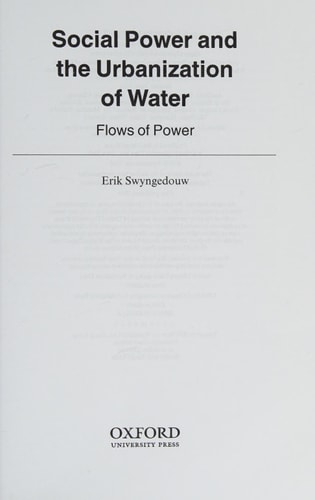
Social Power and the Urbanization of Water: Flows of Power
0
0
As an Amazon Associate and affiliate partner, Menrva Books earns from qualifying purchases. Learn more
Author Description
Taking as his case-study the city of Guayaquil in Ecuador, where 600,000 people lack easy access to potable water, Erik Swyngedouw aims to reconstruct, theoretically and empirically, the political, social, and economic conduits through which water flows, and to identify how power relations infuse the metabolic transformation of water as it becomes urban. These flows of water which are simultaneously physical and social carry in their currents the embodiment of myriad social struggles and conflicts. The excavation of these flows narrates stories about the city's structure and development. Yet these flows also carry the potential for an improved, more just, and more equitable right to the city and its water. The flows of power that are captured by urban water circulation also suggest that the question of urban sustainability is not just about achieving sound ecological and environmental conditions, but first and foremost about a social struggle for access and control; a struggle not just for the right to water, but for the right to the city itself.
Menrva's Summary
THE THESIS
This work investigates how political, social, and economic power structures dictate the distribution and management of water within urban environments. Erik Swyngedouw, a prominent scholar in political ecology, utilizes the city of Guayaquil, Ecuador, as a primary case study to demonstrate that water circulation is not merely a technical or ecological process but a deeply political one. By analyzing the metabolic transformation of water, the author argues that urban sustainability is fundamentally a struggle for social equity and the right to the city rather than a purely environmental challenge.
THE SCOPE MAP
What You Will Find
- A detailed case study of water infrastructure and access in Guayaquil, Ecuador.
- Theoretical frameworks linking urban metabolism to political power dynamics.
- Empirical analysis of social struggles surrounding resource control and urban development.
- An examination of the intersection between ecological sustainability and social justice.
THE AUTHORITY PERSPECTIVE
Scholars in urban geography and political ecology frequently cite this text as a foundational contribution to the study of urban water systems. Readers often note the academic density of the prose, which provides a rigorous analytical lens for understanding the socio-political dimensions of environmental resources.
Page Count:
226
Publication Date:
2004-05-06
Publisher:
Oxford University Press
ISBN-10:
0198233914
ISBN-13:
9780198233916
Sociology
Urban Studies
Geography
Water Supply
Community Tags
Similar Books