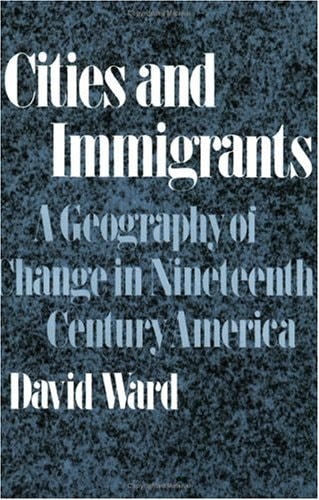
Cities and Immigrants: A Geography of Change in Nineteenth-Century America
0
0
As an Amazon Associate and affiliate partner, Menrva Books earns from qualifying purchases. Learn more
Author Description
Studies the effects of economic growth and immigration upon urbanization, as well as employment, housing, and transportation in American cities from 1820 to 1920
Menrva's Summary
THE THESIS
How did the rapid influx of immigrants and the acceleration of economic growth fundamentally reshape the spatial and social structure of American cities during the nineteenth century? David A. Ward, a scholar of urban geography, examines the intersection of demographic shifts and industrial expansion to explain the evolution of the American urban landscape. By analyzing data from 1820 to 1920, the author argues that the physical layout of cities was not merely a product of growth, but a direct response to the needs and constraints of a changing immigrant workforce. The text provides a framework for understanding how housing, transportation, and employment patterns were inextricably linked to the waves of migration that defined the era.
THE SCOPE MAP
What You Will Find
- Analysis of urban development patterns from 1820 to 1920.
- Examination of the relationship between industrial economic growth and city expansion.
- Investigation into the spatial distribution of immigrant populations within metropolitan centers.
- Evaluation of how transportation infrastructure and housing availability influenced social stratification.
THE AUTHORITY PERSPECTIVE
Experts recognize this work as a foundational text for understanding the historical geography of American urbanization. Readers frequently note the academic density of the prose, which provides a rigorous look at the structural forces that built the modern city.
Page Count:
180
Publication Date:
1971-01-01
Publisher:
Oxford
ISBN-10:
0195012763
ISBN-13:
9780195012767
History
Politics
Urban
Sociology
Urban Studies
American History
Geography
Immigration