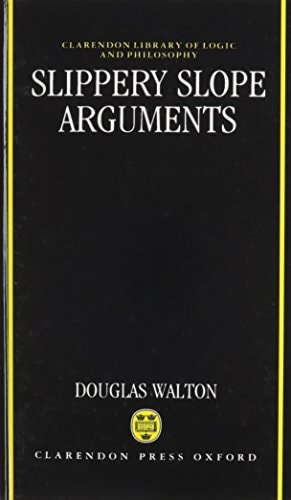
Slippery Slope Arguments
0
0
As an Amazon Associate and affiliate partner, Menrva Books earns from qualifying purchases. Learn more
Author Description
A "slippery slope argument" is a type of argument in which a first step is taken and a series of inextricable consequences follow, ultimately leading to a disastrous outcome. Many textbooks on informal logic and critical thinking treat the slippery slope argument as a fallacy. Walton argues that used correctly in some cases, they can be a reasonable type of argument to shift a burden of proof in a critical discussion, while in other cases they are used incorrectly. Walton identifies and analyzes four types of slippery slope argument. Walton presents guidelines that show how each type of slippery slope argument can be used correctly or incorrectly, using over fifty case studies of argumentation on controversial issues. These include abortion, medical research on human embryos, euthanasia, the decriminalization of marijuana, pornography, and censorship, and banning of American flag burning.
Menrva's Summary
THE THESIS
This work investigates whether the slippery slope argument is inherently fallacious or if it can function as a legitimate tool for shifting the burden of proof in critical discourse. Douglas Walton, a prominent scholar in argumentation theory, utilizes a rigorous analytical framework to challenge the traditional pedagogical view that slippery slope arguments are always logical errors. By examining the structural components of these arguments, he establishes criteria for distinguishing between valid reasoning and fallacious manipulation in public and private debate.
THE SCOPE MAP
What You Will Find
- A taxonomy identifying four distinct types of slippery slope arguments.
- A set of normative guidelines for evaluating the validity of sequential reasoning.
- Over fifty case studies covering controversial topics such as euthanasia, abortion, and censorship.
- An analysis of the burden of proof within the context of informal logic.
THE AUTHORITY PERSPECTIVE
Experts in the field of logic and philosophy recognize this text as a foundational resource for understanding the mechanics of informal fallacies. Readers frequently note the academic density of the prose, which is tailored for students and scholars of argumentation theory.
Page Count:
312
Publication Date:
1992-05-07
Publisher:
Clarendon Press
ISBN-10:
0198239254
ISBN-13:
9780198239253
Philosophy
Critical thinking
Logic
Rhetoric
Community Tags
Similar Books