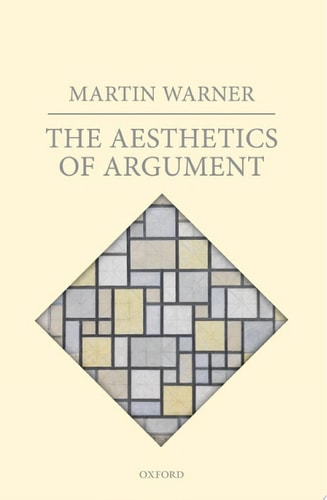
The Aesthetics of Argument
0
0
As an Amazon Associate and affiliate partner, Menrva Books earns from qualifying purchases. Learn more
Author Description
Argument and imagination are often interdependent. The Aesthetics of Argument is concerned with how this relationship may bear on argument's concern with truth, not just persuasion, and with the enhancement of understanding such interdependence may bring. The rationality of argument, conceived as the advancement of reasons for or against a claim, is not simply a matter of deductive validity. Whether arguments are relevant, have force, or look foolish--or whether an example is telling or merely illustrative--cannot always be assessed in these terms. Martin Warner presents a series of case studies which explore how analogy, metaphor, narrative, image, and symbol can be used in different ways to frame one domain in terms of another, severally or in various combinations, and how criteria drawn from the study of imaginative literature may have a bearing on their truth-aptness. Such framing can be particularly effective in argumentative roles which invite self-interrogation, as Plato saw long ago. Narrative in such cases may be fictional, whether parabolic or dramatic, autobiographical or biographical, and in certain cases may seek to show how standard conceptualizations are inadequate. Beyond this, whether in poetry or prose and not only with respect to narrative, the "logic" of imagery enables us to make principled sense of our capacity to grasp imagistically elements of our experience through words whose use at the imaginative level has transformed their standard conceptual relationships, and hence judge the credibility of associated arguments. Assessment of the argumentative imagination requires criteria drawn not only from dialectic and rhetoric, but also from poetics.
Menrva's Summary
THE THESIS
This book investigates the intersection of imagination and rational argument to determine how non-logical elements contribute to the pursuit of truth. Martin Warner, a scholar in philosophy and literature, argues that traditional deductive logic is insufficient for assessing the full force and relevance of human reasoning. By integrating criteria from poetics with those of dialectic and rhetoric, he proposes a framework for evaluating how imaginative structures like metaphor and narrative function within argumentative discourse.
THE SCOPE MAP
What You Will Find
- Analysis of how analogy, metaphor, narrative, image, and symbol frame conceptual domains.
- Examination of the "logic" of imagery and its role in transforming standard conceptual relationships.
- Case studies exploring the argumentative utility of fictional, parabolic, and biographical narratives.
Scope Limits
- The text does not provide a comprehensive manual for formal logic or deductive proof.
- It does not focus on political or legal rhetoric, but rather on the philosophical underpinnings of argumentative imagination.
THE AUTHORITY PERSPECTIVE
Scholars and students of philosophy frequently note the academic density of the prose and the interdisciplinary nature of the inquiry. Experts highlight this as a significant contribution to the study of how literary devices influence the truth-aptness of philosophical arguments.
Page Count:
336
Publication Date:
2016-01-01
Publisher:
OUP Oxford
ISBN-10:
0191056928
ISBN-13:
9780191056925
Philosophy
Epistemology
Imagination
Rhetoric
Aesthetics
Logic
Reasoning
Literary theory
Community Tags
Other Editions(3)

Similar Books
Reader Comments
Share Your Thoughts
No comments yet. Be the first to share your thoughts!