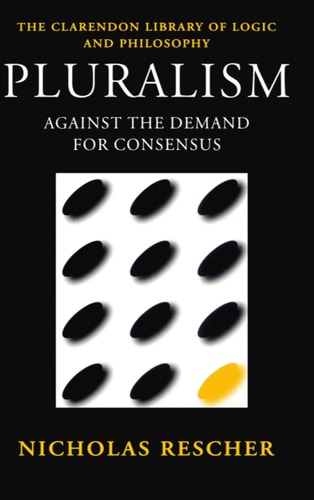
Pluralism: Against the Demand for Consensus
0
0
As an Amazon Associate and affiliate partner, Menrva Books earns from qualifying purchases. Learn more
Author Description
Nicholas Rescher presents a critical reaction against two currently influential tendencies of thought. On the one hand, he rejects the facile relativism that pervades contemporary social and academic life. On the other hand, he opposes the rationalism inherent in neo-contractarian theory--both in the idealized communicative-contract version promoted in continental European political philosophy by J;urgen Habermas, and in the idealized social contract version of the theory of political justice promoted in the Anglo-American context by John Rawls. Against such tendencies, Rescher's pluralist approach takes a more realistic and pragmatic line, eschewing the convenient recourse of idealization in cognitive and practical matters. Instead of a utopianism that looks to a uniquely perfect order that would prevail under ideal conditions, he advocates incremental improvements within the framework of arrangements that none of us will deem perfect but that all of us "can live with." Such an approach replaces the yearning for an unattainable consensus with the institution of pragmatic arrangements in which the community will acquiesce--not through agreeing on their optimality, but through a shared recognition among the dissonant parties that the available options are even worse.
Menrva's Summary
THE THESIS
This work investigates the viability of consensus as a political and social ideal, arguing instead for a pluralistic framework based on pragmatic acquiescence. Nicholas Rescher, a distinguished philosopher, challenges the prevailing reliance on idealized rationalism found in the works of thinkers like John Rawls and Jürgen Habermas. By rejecting both extreme relativism and the utopian search for perfect social contracts, he proposes a model of incremental improvement that prioritizes functional, liveable arrangements over theoretical optimality.
THE SCOPE MAP
What You Will Find
- A critique of neo-contractarian political theories and their reliance on idealized communicative conditions.
- An analysis of the limitations inherent in seeking universal consensus within diverse, dissonant communities.
- A philosophical defense of pluralism as a realistic alternative to both relativism and rationalist utopianism.
- A pragmatic framework for social cooperation based on the mutual recognition of suboptimal but acceptable alternatives.
THE AUTHORITY PERSPECTIVE
Scholars and students of political philosophy frequently cite this text as a rigorous counterpoint to the dominant consensus-based theories of the late 20th century. Experts highlight the book's utility in bridging the gap between abstract logical inquiry and practical social application.
Page Count:
216
Publication Date:
1995-10-26
Publisher:
Clarendon Press
ISBN-10:
0198236018
ISBN-13:
9780198236016
Philosophy
Pluralism
Pragmatism
Logic
Social Philosophy
Political Philosophy
Community Tags
Similar Books