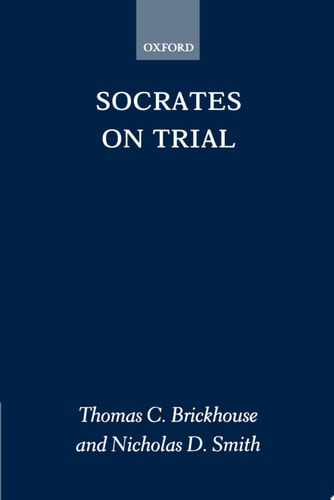
Socrates on Trial
0
0
As an Amazon Associate and affiliate partner, Menrva Books earns from qualifying purchases. Learn more
Author Description
Brickhouse and Smith argue, contrary to virtually every modern interpretation of Plato's Apology of Socrates, that Plato's Socrates offers a sincere defence against the charges he faces. In doing so the book offers an exhaustive historical and philosophical interpretation of and commentary on Plato's Apology. The authors demonstrate that Socrates' moral and religious principles prohibit him from needlessly risking a negative vote at his trial. By providing a complete commentary, they show that each specific claim Socrates makes in the Apology can be construed as a sincere attempt to inform the jury of the truth and convince the jurors of his blamelessness. The effect of these two strategies is a novel interpretation of the Apology which sheds new light on various aspects of Socrates' life and philosophy.
Menrva's Summary
THE THESIS
Does Plato's Apology represent a sincere defense by Socrates, or is it a calculated rhetorical performance designed to provoke his own condemnation? Thomas C. Brickhouse and Nicholas D. Smith, both established scholars in ancient philosophy, challenge the prevailing academic consensus that Socrates intentionally sought his own execution. By applying rigorous historical and philosophical analysis to the text of the Apology, the authors argue that Socrates' core moral and religious commitments necessitated a genuine attempt to persuade the Athenian jury of his innocence.
THE SCOPE MAP
What You Will Find
- A comprehensive, line-by-line philosophical commentary on Plato's Apology.
- An analysis of the legal and social constraints of the Athenian judicial system.
- Examination of Socratic moral principles regarding truth-telling and civic duty.
- A reconstruction of the historical context surrounding the trial of Socrates.
THE AUTHORITY PERSPECTIVE
Scholars frequently cite this work as a significant departure from traditional interpretations of Socratic irony, noting its meticulous attention to the text. It is widely regarded as a foundational resource for students and researchers examining the intersection of Socratic ethics and Athenian law.
Page Count:
354
Publication Date:
2000-12-31
Publisher:
Clarendon Press
ISBN-10:
0198239386
ISBN-13:
9780198239383
Philosophy
Biography
Politics
Greek & Roman
Ethics
Ancient History