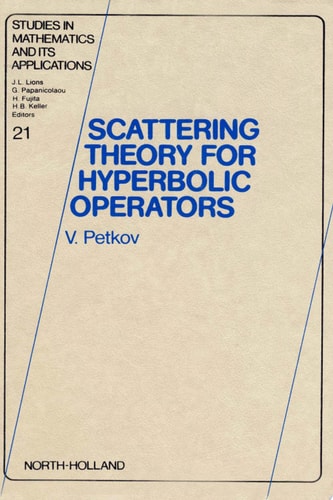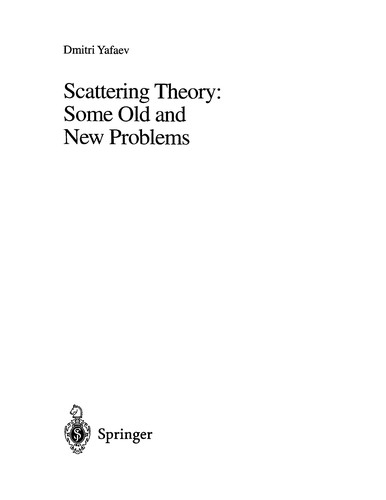
Scattering Theory
0
0
As an Amazon Associate and affiliate partner, Menrva Books earns from qualifying purchases. Learn more
Author Description
Scattering theory is, roughly speaking, perturbation theory of self-adjoint operators on the (absolutely) continuous spectrum. It has its origin in mathematical problems of quantum mechanics and is intimately related to the theory of partial differential equations. Some recently solved problems, such as asymptotic completeness for the Schrödinger operator with long-range and multiparticle potentials, as well as open problems, are discussed. Potentials for which asymptotic completeness is violated are also constructed. This corresponds to a new class of asymptotic solutions of the time-dependent Schrödinger equation. Special attention is paid to the properties of the scattering matrix, which is the main observable of the theory. The book is addressed to readers interested in a deeper study of the subject.
Menrva's Summary
THE THESIS
This book investigates the mathematical framework of perturbation theory applied to self-adjoint operators within the continuous spectrum, focusing on its origins in quantum mechanics and its connections to partial differential equations. The author, D. R. I︠A︡faev, draws upon expertise in mathematical physics to explore both solved and open problems in scattering theory. The text delves into the construction of potentials that violate asymptotic completeness, leading to novel asymptotic solutions for the time-dependent Schrödinger equation. Central to the discussion are the properties of the scattering matrix, identified as the primary observable in this field.
THE SCOPE MAP
- What You Will Find:
- Perturbation theory of self-adjoint operators on the continuous spectrum
- Mathematical problems originating from quantum mechanics
- Connections to the theory of partial differential equations
- Discussion of asymptotic completeness for Schrödinger operators with various potentials
- Construction of potentials for which asymptotic completeness is violated
- New classes of asymptotic solutions for the time-dependent Schrödinger equation
- Properties of the scattering matrix as the main observable
THE AUTHORITY PERSPECTIVE
The book is aimed at readers seeking a deeper understanding of scattering theory, indicating a specialized and advanced audience. Its focus on both established results and open problems suggests a text that engages with the current state of research in mathematical physics. The detailed exploration of potentials and their impact on asymptotic completeness points to a rigorous, theoretical treatment of the subject. The emphasis on the scattering matrix highlights its significance as a key element in the observable aspects of quantum mechanical systems.
Page Count:
169
Publication Date:
2000-01-01
ISBN-10:
3540675876
Non-Fiction
Science
Art
Operator Theory
Mathematical Physics
Community Tags
Similar Books