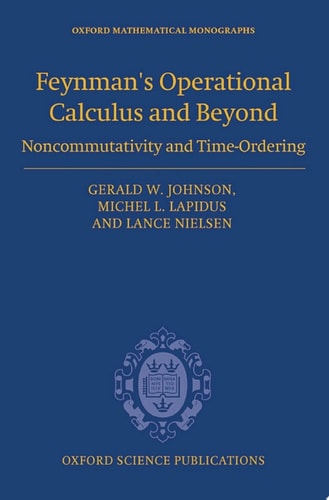
Feynman's Operational Calculus and Beyond: Noncommutativity and Time-Ordering
0
0
As an Amazon Associate and affiliate partner, Menrva Books earns from qualifying purchases. Learn more
Author Description
This book is aimed at providing a coherent, essentially self-contained, rigorous and comprehensive abstract theory of Feynman's operational calculus for noncommuting operators. Although it is inspired by Feynman's original heuristic suggestions and time-ordering rules in his seminal 1951 paper An operator calculus having applications in quantum electrodynamics, as will be made abundantly clear in the introduction (Chapter 1) and elsewhere in the text, the theory developed in this book also goes well beyond them in a number of directions which were not anticipated in Feynman's work. Hence, the second part of the main title of this book. The basic properties of the operational calculus are developed and certain algebraic and analytic properties of the operational calculus are explored. Also, the operational calculus will be seen to possess some pleasant stability properties. Furthermore, an evolution equation and a generalized integral equation obeyed by the operational calculus are discussed and connections with certain analytic Feynman integrals are noted. This volume is essentially self-contained and we only assume that the reader has a reasonable, graduate level, background in analysis, measure theory and functional analysis or operator theory. Much of the necessary remaining background is supplied in the text itself.
Menrva's Summary
THE THESIS
This text investigates the construction of a rigorous, abstract mathematical framework for Feynman's operational calculus applied to noncommuting operators. The authors, experts in functional analysis and mathematical physics, utilize a combination of algebraic and analytic methods to extend Richard Feynman's original 1951 heuristic time-ordering rules into a comprehensive, self-contained theory that addresses stability and evolution equations.
THE SCOPE MAP
What You Will Find
- A formalization of Feynman's operational calculus for noncommuting operators
- Analysis of algebraic and analytic properties of the operational calculus
- Derivation of evolution equations and generalized integral equations
- Connections between operational calculus and analytic Feynman integrals
Scope Limits
- The text assumes the reader possesses a graduate-level background in measure theory and functional analysis
- It does not provide an introductory overview of basic quantum electrodynamics outside the context of the operational calculus
THE AUTHORITY PERSPECTIVE
Experts recognize this volume as a specialized, rigorous treatment of operator theory that bridges the gap between heuristic physics and formal mathematics. Readers frequently note the high level of academic density, making it a primary resource for researchers and graduate students in mathematical physics.
Page Count:
368
Publication Date:
2015-01-01
Publisher:
OUP Oxford
ISBN-10:
0191006882
ISBN-13:
9780191006883
Functional analysis
Physics
Operator Theory
Mathematics
Earth Sciences
Mathematical Physics
Community Tags
Similar Books