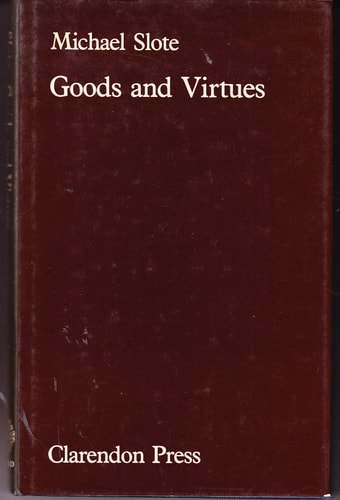
Goods and Virtues
0
0
As an Amazon Associate and affiliate partner, Menrva Books earns from qualifying purchases. Learn more
Author Description
This important and provocative book offers a critique of prevalent approaches to human good and virtue. Slote argues that some personal good and virtues are less absolute than is recognized, being either relative to times of life or possible worlds, or dependent for their value on other goods and virtues. He also criticizes certain familiar restrictions on what counts as a good or virtue, and defends the idea of contra-moral virtues and goods that do not yield reasons for action. The book demonstrates that typical philosophical accounts of the virtues and human goods oversimplify the phenomena, and that a more exact approach is needed.
Menrva's Summary
THE THESIS
This book investigates the limitations of traditional philosophical frameworks regarding human good and virtue by questioning their perceived absolute nature. Michael Slote, a prominent philosopher, challenges the conventional view that virtues and personal goods are universally applicable across all contexts. He argues that many virtues are contingent upon specific life stages or hypothetical scenarios, suggesting that current academic discourse often oversimplifies the complexity of moral value. By introducing the concept of contra-moral virtues, Slote provides a new analytical framework for understanding how certain goods function independently of traditional moral reasoning.
THE SCOPE MAP
What You Will Find
- A critical analysis of absolute versus relative virtues and personal goods.
- The introduction and defense of contra-moral virtues that do not necessitate action.
- An examination of how life stages and possible worlds influence the value of specific virtues.
- A critique of existing philosophical restrictions on the definition of human good.
THE AUTHORITY PERSPECTIVE
Experts in moral philosophy recognize this work as a significant contribution to the field of virtue ethics. Readers frequently note the academic density of the prose and the rigorous logical structure employed by the author to dismantle traditional ethical assumptions.
Page Count:
168
Publication Date:
1990-01-18
Publisher:
Oxford University Press
ISBN-10:
0198244630
ISBN-13:
9780198244639
Philosophy
Ethics
Consumption Economics
Virtue Ethics
Moral Philosophy