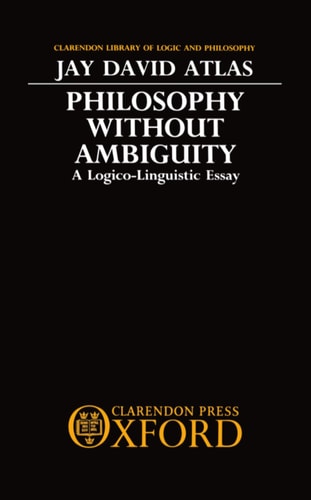
Philosophy without Ambiguity: A Logico-Linguistic Essay
0
0
As an Amazon Associate and affiliate partner, Menrva Books earns from qualifying purchases. Learn more
Author Description
This book expounds and defends a new conception of the relation between truth and meaning. Atlas argues that the sense of a sense-general sentence radically underdetermines (independently of indexicality) its truth-conditional content. He applies this linguistic analysis to illuminate old and new philosophical problems of meaning, truth, falsity, negation, existence, presupposition, and implicature. In particular, he demonstrates how the concept of ambiguity has been misused and confused with other concepts of meaning, and how the interface between semantics and pragmatics has been misunderstood. The problems he tackles are common to philosophy, linguistics, cognitive psychology, and artificial intelligence, and his conclusions will be of interest to all those working in these fields.
Menrva's Summary
THE THESIS
This work investigates the relationship between truth and meaning by arguing that the sense of a sentence radically underdetermines its truth-conditional content. Jay David Atlas, a scholar in the field of analytic philosophy, utilizes a logico-linguistic framework to challenge traditional interpretations of ambiguity. By examining the interface between semantics and pragmatics, he provides a rigorous analysis of how meaning is constructed and interpreted in both natural language and formal logic.
THE SCOPE MAP
What You Will Find
- A re-evaluation of the concept of ambiguity versus other meaning-related phenomena.
- An analysis of truth-conditional content and its relation to sense-general sentences.
- Application of linguistic theory to philosophical problems including negation, existence, and presupposition.
- Interdisciplinary insights relevant to cognitive psychology and artificial intelligence.
THE AUTHORITY PERSPECTIVE
Experts recognize this text as a significant contribution to the philosophy of language, particularly for its precise treatment of semantic underdetermination. Readers frequently note the academic density of the prose, which requires a strong background in formal logic and linguistic theory to fully grasp the author's arguments.
Page Count:
200
Publication Date:
1989-10-05
Publisher:
Clarendon Press
ISBN-10:
0198244541
ISBN-13:
9780198244547
Philosophy
Semantics
Logic
Pragmatics
Linguistics
Truth
Ambiguity
Language and logic
Community Tags
Similar Books