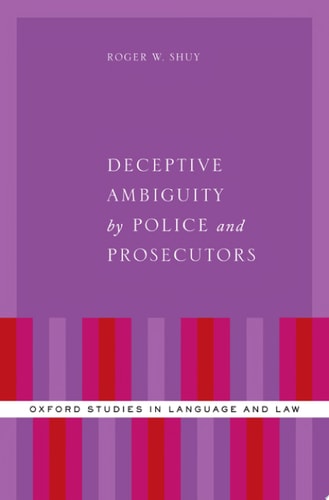
Deceptive Ambiguity by Police and Prosecutors
0
0
As an Amazon Associate and affiliate partner, Menrva Books earns from qualifying purchases. Learn more
Author Description
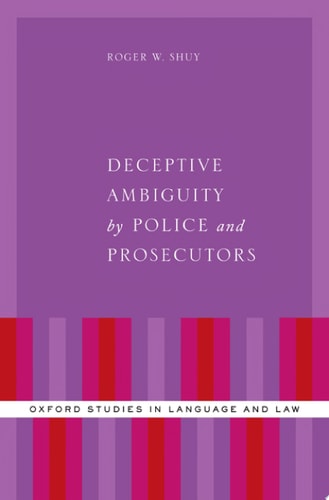
Much has been written about how criminal suspects, defendants, and the targets of undercover operations employ ambiguous language as they interact with the legal system. This book examines the other side of the coin, describing fifteen criminal investigations that demonstrate how police, prosecutors, and undercover agents use deceptive ambiguity with their subjects and targets, thereby creating misrepresentations through their uses of speech events, schemas, agendas, speech acts, lexicon, and grammar. This misrepresentation also can strongly affect the perceptions of later listeners, such as judges and juries, about the subjects' motives, predispositions, intentions, and voluntariness. Deception is commonly considered intentional while ambiguity is often excused as unintentional, in line with Grice's maxim of sincerity in his cooperative principle. Most of the interactions of suspects, defendants, and targets with representatives of law enforcement, however, are oppositional, adversarial, and non-cooperative events that provide the opportunity for participants to stretch, ignore, or even violate the cooperative principle. One effective way law enforcement does this is by using ambiguity. Suspects and defendants may hear such ambiguous speech and not recognize the ambiguity and therefore react in ways that they may not have understood or intended. The fifteen case studies in this book illustrate how deceptive ambiguity, whether intentional or not, is used as commonly by police, prosecutors and undercover agents as it is by suspects and defendants.
Menrva's Summary
THE THESIS
This book investigates how law enforcement officials and prosecutors employ deceptive ambiguity to manipulate criminal investigations and influence judicial outcomes. Roger W. Shuy, a prominent forensic linguist, utilizes his extensive academic background to analyze the intersection of language and legal procedure. He argues that the adversarial nature of police-suspect interactions allows authorities to exploit linguistic ambiguity, thereby shaping the perceptions of judges and juries regarding a suspect's intent and voluntariness.
THE SCOPE MAP
What You Will Find
- Analysis of fifteen distinct criminal case studies involving undercover operations.
- Examination of linguistic mechanisms including speech acts, schemas, and lexical choices.
- Application of Grice's cooperative principle to adversarial legal settings.
Scope Limits
- The text focuses primarily on the linguistic strategies of law enforcement rather than the legal defense strategies of the accused.
- It does not provide a comprehensive legal manual for trial procedure but rather a linguistic critique of investigative communication.
THE AUTHORITY PERSPECTIVE
Experts in forensic linguistics recognize this work as a significant contribution to the study of language in the courtroom. Readers frequently note the academic density of the prose, which requires a foundational understanding of linguistic theory to fully grasp the implications of the case studies presented.
Page Count:
240
Publication Date:
2017-01-01
Publisher:
Oxford University Press
ISBN-10:
019066990X
ISBN-13:
9780190669904
Administration of Justice
Criminology
Deception
Linguistics
Forensic Linguistics
Law
Ambiguity