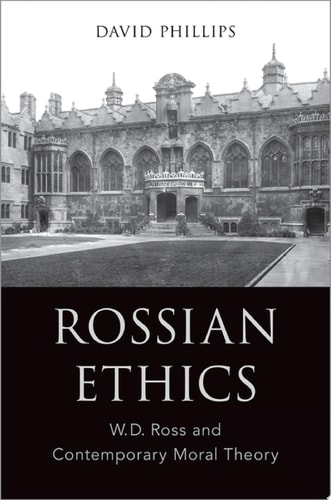
Rossian Ethics: W.D. Ross and Contemporary Moral Theory
0
0
As an Amazon Associate and affiliate partner, Menrva Books earns from qualifying purchases. Learn more
Author Description
W.D. Ross (1877-1971) was the most important opponent of utilitarianism and consequentialism in British moral philosophy between 1861 and 1939. In Rossian Ethics, David Phillips offers the first monograph devoted exclusively to Ross's seminal contribution to moral philosophy.The book has two connected aims. The first is to interpret and evaluate Ross's moral theory, focusing on its three key elements: his introduction of the concept of prima facie duty, his limited pluralism about the right, and his limited pluralism about the good. The metaethical and epistemological framework within which Ross develops his moral theory is the subject of the fifth and final chapter of the book. The second aim is to articulate a distinctive view intermediate between consequentialism and absolutist deontology, which Phillips calls "classical deontology." According to classical deontology the most fundamental normative principles are principles of prima facie duty, principles which specify general kinds of reasons. Consequentialists are right to think that reasons always derive from goods; ideal utilitarians are right, contra hedonistic utilitarians, to think that there are a small number of distinct kinds of intrinsic goods. But consequentialists are wrong to think that all reasons have the same weight for all agents. Instead there are a small number of distinct kinds of agent-relative intensifiers: features that increase the importance of certain goods for certain agents. Phillips claims that classical deontology combines the best elements of the moral theories of Ross and of Sidgwick, ultimately arguing that Ross is best interpreted as a classical deontologist.
Menrva's Summary
THE THESIS
This book investigates the moral philosophy of W.D. Ross to determine his role as a primary critic of utilitarianism and to establish a framework for classical deontology. David Phillips, a scholar of moral theory, utilizes a rigorous analytical approach to evaluate Ross's concepts of prima facie duty and pluralism. By synthesizing Ross's historical contributions with contemporary normative concerns, the author constructs a bridge between traditional deontology and consequentialist thought.
THE SCOPE MAP
What You Will Find
- An analysis of Ross's three key elements: prima facie duty, pluralism about the right, and pluralism about the good.
- A metaethical and epistemological examination of Ross's moral framework.
- The articulation of 'classical deontology' as an intermediate position between consequentialism and absolutist deontology.
Scope Limits
- The text focuses primarily on the moral theories of Ross and Sidgwick rather than a comprehensive survey of all 20th-century moral philosophers.
- The analysis is restricted to the normative and metaethical dimensions of Ross's work.
THE AUTHORITY PERSPECTIVE
Experts recognize this monograph as the first dedicated study of W.D. Ross's moral philosophy, providing a necessary clarification of his often-misunderstood positions. Readers frequently note the academic density of the prose, which is intended for students and scholars of moral theory.
Page Count:
226
Publication Date:
2019-01-01
Publisher:
Oxford University Press
ISBN-10:
0190054654
ISBN-13:
9780190054656
Philosophy
Political
Social Philosophy
Ethics
Academic
Moral Philosophy
ethics philosophy
Deontology
Community Tags
Similar Books