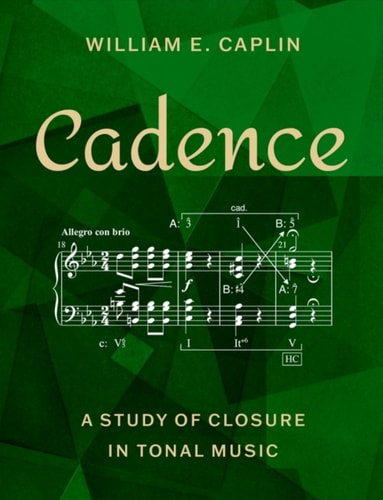
Cadence
0
0
As an Amazon Associate and affiliate partner, Menrva Books earns from qualifying purchases. Learn more
Author Description
Cadence is a comprehensive examination of how formal units in European art music of the tonal era achieve closure. The book brings together the author's decades-long investigations into cadence, a compositional device that is readily experienced both by musicians and non-musicians, but one that has proven intractable to clear and precise theoretical formulation. Rooted in Caplin's broader theory of formal functions, the book first develops concepts of cadence for music of the high classical style and then extends these ideas to gauge cadential practice in earlier and later style periods. Throughout the study, various manifestations of cadence are defined in terms of their morphology (their harmonic and melodic profiles) as well as their function (the specific formal contexts in which they are deployed). Cadence introduces a host of theoretical concepts illustrated by copious musical examples, all of which contain extensive analytical annotations of harmony, melody and form. Though the book is addressed primarily to music theorists, the many issues of compositional practice raised in this study will resonate with the interests of composers, historians, and performers alike.
Menrva's Summary
THE THESIS
This book investigates the theoretical definition and functional role of cadence as a mechanism for achieving closure in European art music of the tonal era. William E. Caplin, a prominent music theorist, synthesizes decades of research to address the historical difficulty of defining cadential practice. By applying his established theory of formal functions, the author provides a rigorous framework that categorizes cadences based on both their structural morphology and their specific placement within musical form.
THE SCOPE MAP
What You Will Find
- A comprehensive taxonomy of cadential types in high classical style
- Analytical methodologies for evaluating harmonic and melodic profiles
- Extensive musical examples featuring detailed annotations of form and harmony
Scope Limits
- The text focuses primarily on the tonal era and may not apply to atonal or avant-garde compositions
- The analysis is centered on European art music traditions rather than global or popular music forms
THE AUTHORITY PERSPECTIVE
Experts recognize this work as a foundational text for music theorists seeking a precise, functional understanding of musical closure. Readers frequently note the academic density of the prose, which is best suited for those with a strong background in music theory and formal analysis.
Page Count:
212
Publication Date:
2024-09-20
Publisher:
Oxford University Press Academic US
ISBN-10:
0190056452
ISBN-13:
9780190056452
Composition
Academic
Theory
Appreciation
Music theory
Musicology
Community Tags
Similar Books