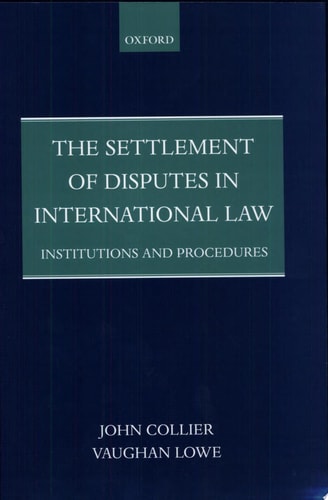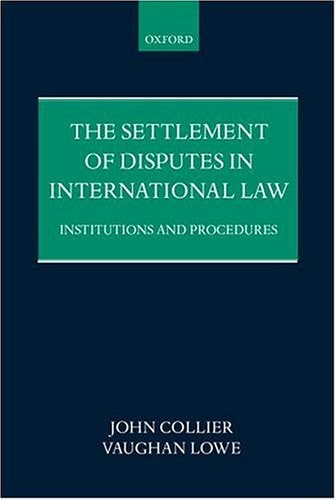
The Settlement of Disputes in International Law: Institutions and Procedures
0
0
As an Amazon Associate and affiliate partner, Menrva Books earns from qualifying purchases. Learn more
Author Description
For many years it was said that the weakness of international law was the lack of a system for the enforcement of legal obligations. Commentators pointed to the paucity of cases in the International Court and the unwillingness of States to undertake binding obligations to settle their disputes. This position has now changed beyond recognition. The number of international tribunals has increased and many of them, such as ICSID and the International Court of Justice, are busier than at any time in their history. Increasingly, the classical procedures of diplomatic protection are circumvented as corporations and individuals litigate in their own right against States in international tribunals.This book surveys the range of procedures for the settlement of international disputes, whether the disputes arise between States or between States and corporations or individuals. The first part of the book examines non-judicial procedures such as negotiation, mediation, fact-finding, as well as judicial procedures. Among the tribunals covered are ICSID, the UNCC and the Iran-US Claim Tribunal, the WTO disputes panels, ad-hoc inter-State and international commercial arbitral tribunals and the International Court of Justice. In the second part of the book the emerging principles of procedural law applied in these tribunals are discussed. Here the authors go through the entire settlement process from the agreement to submit to a settlement procedure and the constitution of the tribunal, through to the determination of the law applicable to the merits and to the procedure of the tribunal, to the review, and ultimately the recognition and enforcement of tribunal awards.
Menrva's Summary
THE THESIS
This book investigates the evolution and current efficacy of international dispute resolution mechanisms in an era where state and non-state actors increasingly rely on formal legal channels. John Collier and Vaughan Lowe, both established scholars in the field of international law, synthesize the shift from traditional diplomatic protection to the proliferation of specialized international tribunals. They provide a comprehensive framework that evaluates how legal obligations are enforced and how procedural law is applied across diverse international forums.
THE SCOPE MAP
What You Will Find
- Analysis of non-judicial procedures including negotiation, mediation, and fact-finding.
- Examination of judicial bodies such as the International Court of Justice, ICSID, and the WTO dispute panels.
- Detailed procedural lifecycle coverage from tribunal constitution to the enforcement of final awards.
- Comparative study of disputes involving states, corporations, and private individuals.
THE AUTHORITY PERSPECTIVE
Legal scholars and practitioners frequently cite this work as a foundational text for understanding the mechanics of international litigation. Readers often note the clarity of the procedural analysis, making it a standard reference for those navigating the complexities of international arbitration and adjudication.
Page Count:
424
Publication Date:
1999-12-30
Publisher:
Oxford University Press
ISBN-10:
0198256698
ISBN-13:
9780198256694
Law
International Law
Reference