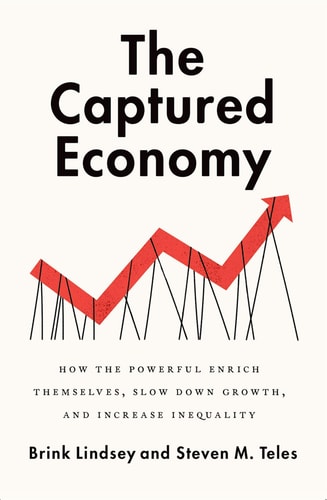
The Captured Economy: How the Powerful Enrich Themselves, Slow Down Growth, and Increase Inequality
0
0
As an Amazon Associate and affiliate partner, Menrva Books earns from qualifying purchases. Learn more
Author Description
For years, America has been plagued by slow economic growth and increasing inequality. In The Captured Economy, Brink Lindsey and Steven M. Teles identify a common factor behind these twin ills: breakdowns in democratic governance that allow wealthy special interests to capture the policymaking process for their own benefit. They document the proliferation of regressive regulations that redistribute wealth and income up the economic scale while stifling entrepreneurship and innovation. They also detail the most important cases of regulatory barriers that have worked to shield the powerful from the rigors of competition, thereby inflating their incomes: subsidies for the financial sector's excessive risk taking, overprotection of copyrights and patents, favoritism toward incumbent businesses through occupational licensing schemes, and the NIMBY-led escalation of land use controls that drive up rents for everyone else. An original and counterintuitive interpretation of the forces driving inequality and stagnation, The Captured Economy will be necessary reading for anyone concerned about America's mounting economic problems and how to improve the social tensions they are sparking.
Menrva's Summary
THE THESIS
The authors investigate how the capture of the democratic policymaking process by wealthy special interests serves as a primary driver for both stagnant economic growth and rising income inequality in the United States. Brink Lindsey and Steven M. Teles, both established policy analysts, utilize a framework of regulatory analysis to demonstrate how specific government interventions are manipulated to benefit incumbent elites. They argue that these regressive regulations stifle innovation and competition, effectively redistributing wealth upward while creating systemic barriers for the broader population.
THE SCOPE MAP
What You Will Find
- Analysis of regulatory capture in the financial sector, intellectual property, and occupational licensing.
- Examination of land use controls and NIMBY-led housing policies.
- A critique of how democratic governance failures facilitate rent-seeking behavior.
Scope Limits
- The text does not provide a comprehensive history of all American economic policy.
- It does not offer a detailed legislative roadmap for specific policy reform.
THE AUTHORITY PERSPECTIVE
Experts and policy analysts frequently cite this work for its clear articulation of how regulatory mechanisms contribute to economic stratification. Readers often note the accessible prose, which translates complex economic theory into a coherent argument regarding the intersection of politics and market competition.
Page Count:
232
Publication Date:
2019-09-01
Publisher:
Oxford University Press
ISBN-10:
0190059001
ISBN-13:
9780190059002
Economics
Politics
Sociology
Governance
Inequality
Systems Theory
Education & Reference
New Used & Rental Textbooks
Economic Policy & Development
Comparative Politics
Public Policy
Specific Topics
Economics
Law
Wealth
Class
Politics & Government
Community Tags
Similar Books