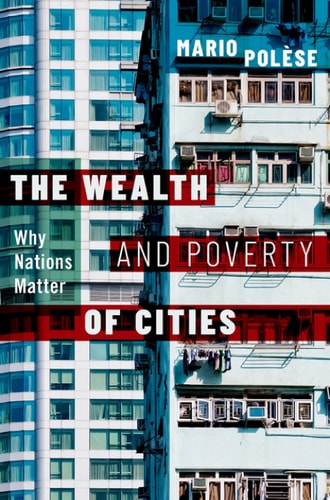
The Wealth and Poverty of Cities: Why Nations Matter
0
0
As an Amazon Associate and affiliate partner, Menrva Books earns from qualifying purchases. Learn more
Author Description
That some cities are vibrant while others are in decline is starkly apparent. In The Wealth and Poverty of Cities, Mario Polèse argues that focusing on city attributes is too narrow. Cities do not control the basic conditions that determine their success or failure as sources of economic growth and well-being.Nations matter because successful metropolitan economies do not spring forth spontaneously. The values, norms, and institutions that shape social relationships are national attributes. The preconditions for the creation of wealth-the rule of law, public education, and sound macroeconomic management among the most fundamental-are the responsibility of the state. By considering national fiscal and monetary policies and state policies governing the organization of cities, this book disentangles two processes: the mechanics of creating wealth and the mechanics of agglomeration or capturing wealth. Polèse explains the two-stage process in which the proper conditions must first be in place for the benefits of agglomeration to fully flower.Polèse interweaves evocative descriptions of various cities, contrasting cities that have been helped or hurt by local and national policies wise or ill-advised. From New York to Vienna, Buenos Aires to Port au Prince, the cities come to life. Throughout the book Polèse highlights four factors that help explain strengths and weaknesses of cities as foci of economic opportunity and social cohesion: institutions, people, centrality, and chance. The result is a nuanced and accessible introduction to the economy of cities and an original perspective on what needs to improve.Cities that have managed to produce livable urban environments for the majority of their citizens mirror the societies that spawned them. Similarly, cities that have failed are almost always signs of more deep-rooted failures. If the nation does not work, neither will its cities.
Menrva's Summary
THE THESIS
This book investigates the fundamental question of why some cities thrive while others decline, arguing that national-level institutions and policies are the primary determinants of urban economic success. Mario Polèse, an expert in urban planning and regional development, utilizes a comparative analysis of global cities to demonstrate that local urban attributes are secondary to the broader national framework. He posits that the creation of wealth is a two-stage process requiring stable national institutions, such as the rule of law and sound macroeconomic management, before the benefits of urban agglomeration can be realized.
THE SCOPE MAP
What You Will Find
- A framework for understanding the interplay between national policy and local economic outcomes.
- Analysis of four key factors: institutions, people, centrality, and chance.
- Comparative case studies of diverse global cities including New York, Vienna, Buenos Aires, and Port au Prince.
Scope Limits
- The text does not provide a comprehensive guide to local municipal management or specific urban design techniques.
- It does not focus on the internal micro-economics of individual businesses within a city.
THE AUTHORITY PERSPECTIVE
Experts and academics in urban economics recognize this work as a significant contribution to the field for its focus on the macro-foundations of urban development. Readers frequently note that the prose is accessible to non-specialists while maintaining the analytical rigor expected in professional policy discussions.
Page Count:
336
Publication Date:
2019-10-01
Publisher:
Oxford University Press
ISBN-10:
0190053712
ISBN-13:
9780190053710
Politics
Economics
Public Policy
Economics
Politics & Government
Sociology
Economic Policy & Development
Wealth
Human Geography
Geography
New Used & Rental Textbooks
Urban Studies
Community Tags
Similar Books