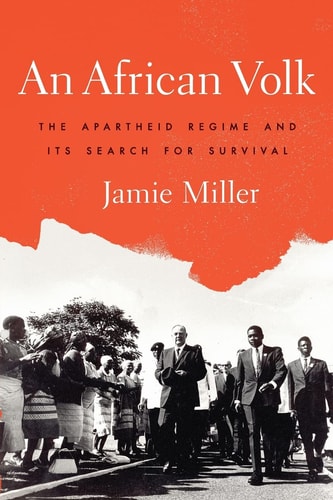
An African Volk: The Apartheid Regime and Its Search for Survival
0
0
As an Amazon Associate and affiliate partner, Menrva Books earns from qualifying purchases. Learn more
Author Description
The demise of apartheid was one of the great achievements of postwar history, sought after and celebrated by a progressive global community. Looking at these events from the other side, An African Volk explores how the apartheid state strove to maintain power as the world of white empire gave way to a post-colonial environment that repudiated racial hierarchy.Drawing upon archival research across Southern Africa and beyond, as well as interviews with leaders of the apartheid order, Jamie Miller shows how the white power structure attempted to turn the new political climate to its advantage. Instead of simply resisting decolonization and African nationalism in the name of white supremacy, the regime looked to co-opt and invert the norms of the new global era to promote a fresh ideological basis for its rule. It adapted discourses of nativist identity, African anti-colonialism, economic development, anti-communism, and state sovereignty to rearticulate what it meant to be African. An African Volk details both the global and local repercussions. At the dawn of the 1970s, the apartheid state reached out eagerly to independent Africa in an effort to reject the mantle of colonialism and redefine the white polity as a full part of the post-colonial world. This outreach both reflected and fuelled heated debates within white society, exposing a deeply divided polity in the midst of profound economic, cultural, and social change.Situated at the nexus of African, decolonization, and Cold War history, An African Volk takes readers into the corridors of white power to detail the apartheid regime's campaign to break out of isolation and secure global acceptance.
Menrva's Summary
THE THESIS
This book investigates how the apartheid regime in South Africa attempted to survive the global shift toward decolonization by rearticulating its identity and co-opting post-colonial political norms. Jamie Miller, a historian specializing in Southern African and Cold War history, utilizes extensive archival research and interviews with former apartheid-era leaders to construct his analysis. He argues that the regime did not merely resist change through force, but actively sought to rebrand itself as a legitimate, post-colonial African state by adopting discourses of sovereignty and anti-communism.
THE SCOPE MAP
What You Will Find
- Analysis of South African foreign policy during the 1970s.
- Examination of the regime's attempts to engage with independent African nations.
- Documentation of internal ideological divisions within the white South African polity.
Scope Limits
- The text focuses primarily on the strategic and ideological maneuvers of the white power structure rather than the grassroots resistance movements.
- It does not provide a comprehensive history of the entire apartheid era, focusing instead on the specific period of transition and attempted adaptation.
THE AUTHORITY PERSPECTIVE
Scholars in the field of African history and international relations recognize this work for its nuanced examination of the apartheid regime's internal logic and its sophisticated use of primary source interviews. Readers frequently note the academic density of the prose, which provides a detailed look at the regime's efforts to navigate the changing global political landscape.
Page Count:
464
Publication Date:
2019-09-01
Publisher:
Oxford University Press
ISBN-10:
0190055545
ISBN-13:
9780190055547
History
Politics
Politics & Government
World politics
Southern Africa
Africa
Afrikaners
World
Race Relations
South Africa
Apartheid
New Used & Rental Textbooks
Specific Topics
Decolonization
Modern History
African history
Cold War
Community Tags
Similar Books