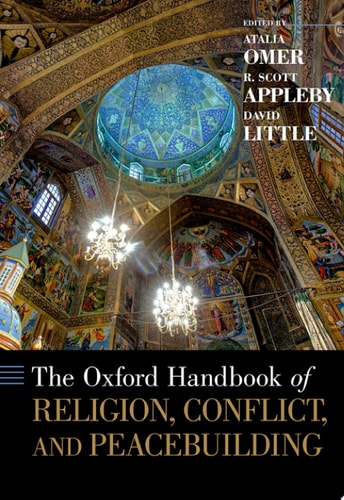
The Oxford Handbook of Religion, Conflict, and Peacebuilding
0
0
As an Amazon Associate and affiliate partner, Menrva Books earns from qualifying purchases. Learn more
Author Description
This volume provides a comprehensive and interdisciplinary account of the scholarship on religion, conflict, and peacebuilding. Looking far beyond the traditional parameters of the field, the contributors engage deeply with the legacies of colonialism, missionary activism, secularism, orientalism, and liberalism as they relate to the discussion of religion, violence, and nonviolent transformation and resistance. Featuring numerous case studies from various contexts and traditions, the volume is organized thematically into five different parts. It begins with an up-to-date mapping of scholarship on religion and violence, and religion and peace. The second part explores the challenges related to developing secularist theories on peace and nationalism, broadening the discussion of violence to include an analysis of cultural and structural forms. In the third section, the chapters explore controversial topics such as religion and development, religious militancy, and the freedom of religion as a keystone of peacebuilding. The fourth part locates notions of peacebuilding in spiritual practice by focusing on constructive resources within various traditions, the transformative role of rituals, youth and interfaith activism in American university campuses, religion and solidarity activism, scriptural reasoning as a peacebuilding practice, and an extended reflection on the history and legacy of missionary peacebuilding. The volume concludes by looking to the future of peacebuilding scholarship and the possibilities for new growth and progress. Bringing together a diverse array of scholars, this innovative handbook grapples with the tension between theory and practice, cultural theory, and the legacy of the liberal peace paradigm, offering provocative, elastic, and context-specific insights for strategic peacebuilding processes.--
Menrva's Summary
THE THESIS
This volume investigates the complex, multifaceted relationship between religious traditions, systemic conflict, and the methodologies employed in peacebuilding efforts. The editors, Atalia Omer, David Little, and R. Scott Appleby, curate an interdisciplinary collection of essays that challenge conventional secularist frameworks. By examining the historical legacies of colonialism and liberalism, the contributors argue for a more nuanced understanding of how religious practice functions as both a catalyst for violence and a resource for nonviolent transformation.
THE SCOPE MAP
What You Will Find
- Analysis of the intersection between secularism, nationalism, and religious militancy.
- Examination of spiritual practices, rituals, and scriptural reasoning as tools for conflict resolution.
- Case studies covering diverse global contexts and interfaith activism.
- Critical review of the liberal peace paradigm and missionary history.
Scope Limits
- The text does not provide a singular, unified theory of peacebuilding but rather a collection of diverse, context-specific perspectives.
- It focuses primarily on academic and theoretical discourse rather than serving as a practical field manual for practitioners.
THE AUTHORITY PERSPECTIVE
Experts identify this handbook as a foundational resource for scholars and advanced students navigating the intersection of theology and international relations. Readers frequently note the academic density of the prose, which demands a high level of familiarity with political theory and religious studies.
Page Count:
712
Publication Date:
2015-01-01
Publisher:
Oxford University Press
ISBN-10:
0190217944
ISBN-13:
9780190217945
History
Politics
Religion
Specific Topics
Religious
Politics & Government
New Used & Rental Textbooks
Religious Aspects
Conflict Resolution
Violence
International relations
Krig
Church & State
Fredsbyggande
Peacebuilding
World
Peace Building
Violence in Society
Sociology
Fred
Community Tags
Other Editions(2)
Similar Books




Reader Comments
Share Your Thoughts
No comments yet. Be the first to share your thoughts!