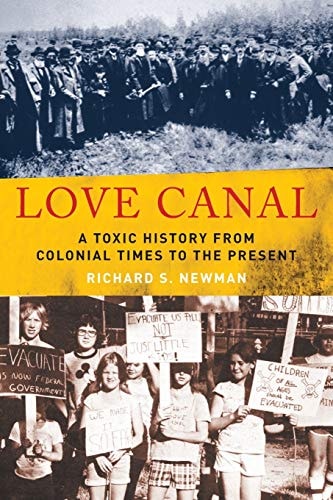
Love Canal: A Toxic History from Colonial Times to the Present
0
0
As an Amazon Associate and affiliate partner, Menrva Books earns from qualifying purchases. Learn more
Author Description
In the summer of 1978, residents of Love Canal, a suburban development in Niagara Falls, NY, began protesting against the leaking toxic waste dump in their midst-a sixteen-acre site containing 100,000 barrels of chemical waste that anchored their neighborhood. Initially seeking evacuation, area activists soon found that they were engaged in a far larger battle over the meaning of America's industrial past and its environmental future. The Love Canal protest movement inaugurated the era of grassroots environmentalism, spawning new anti-toxics laws and new models of ecological protest.Historian Richard S. Newman examines the Love Canal crisis through the area's broader landscape, detailing the way this ever-contentious region has been used, altered, and understood from the colonial era to the present day. Newman journeys into colonial land use battles between Native Americans and European settlers, 19th-century utopian city planning, the rise of the American chemical industry in the 20th century, the transformation of environmental activism in the 1970s, and the memory of environmental disasters in our own time.In an era of hydrofracking and renewed concern about nuclear waste disposal, Love Canal remains relevant. It is only by starting at the very beginning of the site's environmental history that we can understand the road to a hazardous waste crisis in the 1970s-and to the global environmental justice movement it sparked.
Menrva's Summary
THE THESIS
This book investigates how the specific environmental history of the Love Canal site serves as a microcosm for the broader evolution of American industrial land use and the subsequent rise of grassroots environmental activism. Historian Richard S. Newman utilizes a long-term historical framework to connect the 1978 toxic waste crisis to centuries of regional development. By examining the site from its colonial origins through the industrial expansion of the 20th century, Newman argues that the disaster was not an isolated event but the culmination of systemic land-use conflicts. The text provides a comprehensive analysis of how local environmental struggles transformed into a national movement for environmental justice.
THE SCOPE MAP
What You Will Find
- Historical analysis of land use from the colonial era to the present day.
- Documentation of the transition from 19th-century utopian planning to 20th-century chemical industrialization.
- Examination of the 1978 Love Canal protest movement and its legislative impact.
- Contextualization of modern environmental concerns like hydrofracking and nuclear waste.
Scope Limits
- The text does not provide a technical manual for hazardous waste remediation.
- It does not focus exclusively on the 1978 crisis, but rather frames it within a multi-century historical narrative.
THE AUTHORITY PERSPECTIVE
Experts recognize this work as a significant contribution to environmental history for its ability to link local activism with long-term regional development. Readers frequently note the accessible yet rigorous academic approach Newman takes in documenting the evolution of environmental justice movements.
Page Count:
328
Publication Date:
2019-11-15
Publisher:
Oxford University Press
ISBN-10:
0190053844
ISBN-13:
9780190053840
History
Earth Sciences
Geography
United States
American History
Science & Math
Conservation
NATURE Ecology
Industrial history
New Used & Rental Textbooks
Environment
Americas
Community Tags
Similar Books