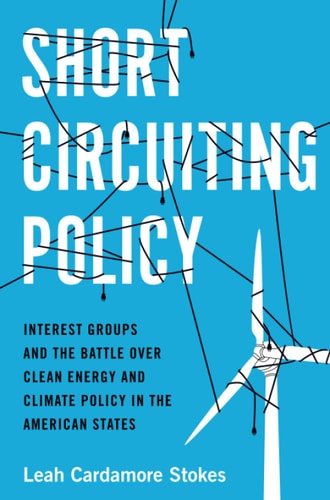
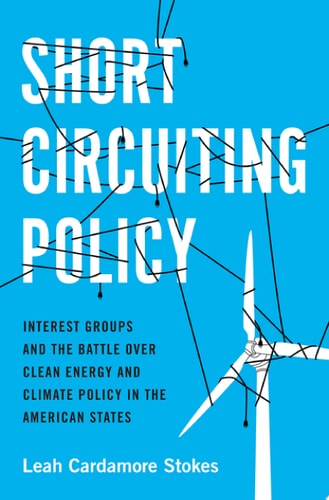
Short Circuiting Policy: Interest Groups and the Battle Over Clean Energy and Climate Policy in the American States
0
0
As an Amazon Associate and affiliate partner, Menrva Books earns from qualifying purchases. Learn more
Author Description
In 1999, Texas passed a landmark clean energy law, beginning a groundswell of new policies that promised to make the US a world leader in renewable energy. As Leah Stokes shows in Short Circuiting Policy, however, that policy did not lead to momentum in Texas, which failed to implement its solar laws or clean up its electricity system. Examining clean energy laws in Texas, Kansas, Arizona, and Ohio over a thirty-year time frame, Stokes argues that organized combat between advocate and opponent interest groups is central to explaining why states are not on track to address the climate crisis. She tells the political history of our energy institutions, explaining how fossil fuel companies and electric utilities have promoted climate denial and delay. Stokes further explains the limits of policy feedback theory, showing the ways that interest groups drive retrenchment through lobbying, public opinion, political parties and the courts. More than a history of renewable energy policy in modern America, Short Circuiting Policy offers a bold new argument about how the policy process works, and why seeming victories can turn into losses when the opposition has enough resources to roll back laws.
Menrva's Summary
THE THESIS
This book investigates why clean energy policies often fail to gain momentum or are actively dismantled despite initial legislative successes. Leah Cardamore Stokes, a political scientist, utilizes a comparative analysis of state-level energy legislation to demonstrate how entrenched interest groups, specifically fossil fuel companies and electric utilities, systematically undermine climate policy. She challenges traditional policy feedback theories by detailing the mechanisms of retrenchment used by these actors to stall progress and maintain the status quo.
THE SCOPE MAP
What You Will Find
- Comparative analysis of clean energy legislation in Texas, Kansas, Arizona, and Ohio.
- Examination of interest group strategies including lobbying, litigation, and public opinion manipulation.
- A critique of policy feedback theory in the context of environmental regulation.
Scope Limits
- The analysis is restricted to the American state-level political context over a thirty-year period.
- The text does not provide a comprehensive global overview of climate policy implementation.
THE AUTHORITY PERSPECTIVE
Experts and political scientists frequently cite this work as a rigorous examination of the political obstacles facing renewable energy transitions. Readers note the academic density of the prose and the depth of the case study research provided.
Page Count:
336
Publication Date:
2020-04-15
Publisher:
Oxford University Press
ISBN-10:
0190074264
ISBN-13:
9780190074265
Politics
Systems Theory
American Politics
Energy policy
United States
Politics & Government
Climatology
General
Science & Math
Specific Topics
Earth Sciences
Social Science
Elections & Political Process
Climate Change
Environmental Conservation
New Used & Rental Textbooks
Social Aspects
Public Policy
Community Tags
Other Editions(2)
Similar Books