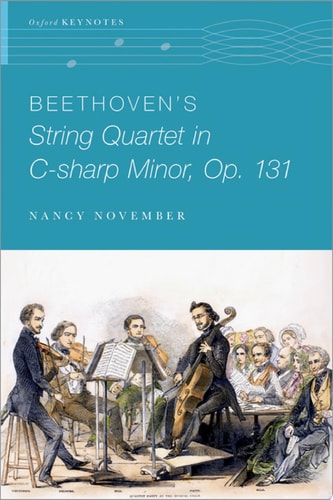
Beethoven's String Quartet in C-sharp Minor, Op. 131
0
0
As an Amazon Associate and affiliate partner, Menrva Books earns from qualifying purchases. Learn more
Author Description
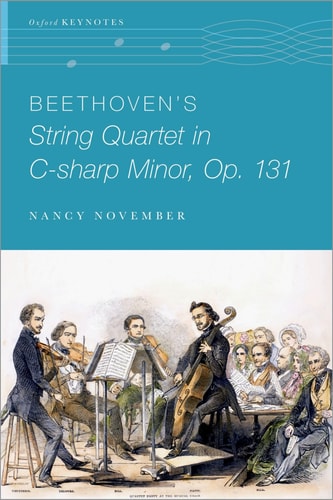
Beethoven's String Quartet in C-sharp minor Op. 131 (1826) is not only firmly a part of the scholarly canon, the performing canon, and the pedagogical canon, but also makes its presence felt in popular culture. Yet in recent times, the terms in which the C-sharp minor quartet is discussed and presented tend to undermine the multivalent nature of the work. Although it is held up as a masterpiece, Op. 131 has often been understood in monochrome terms as a work portraying tragedy, struggle, and loss.In Beethoven's String Quartet in C-sharp Minor, Op. 13, author Nancy November takes the modern-day listener well beyond these categories of adversity or deficit. The book goes back to early reception documents, including Beethoven's own writings about the work, to help the listener reinterpret and re-hear it. This book reveals the diverse musical ideas present in Op. 131 and places the work in the context of an emerging ideology of silent or 'serious' listening in Beethoven's Europe. It considers how this particular 'late' quartet could speak with special eloquence to a highly select but passionately enthusiastic audience and examines how and why the reception of Op. 131 has changed so profoundly from Beethoven's time to our own.
Menrva's Summary
THE THESIS
This book investigates how the historical reception and modern interpretation of Beethoven's String Quartet in C-sharp minor, Op. 131, have narrowed the work's meaning into a singular narrative of tragedy and struggle. Nancy November, a scholar specializing in Beethoven's late works, challenges these reductive views by examining primary source documents and the composer's own writings. She argues that the quartet was originally conceived within a specific cultural context of 'serious' listening, which modern audiences have largely overlooked. By recontextualizing the piece, the author provides a framework for hearing the work's inherent musical diversity beyond its established reputation as a somber composition.
THE SCOPE MAP
What You Will Find
- Historical reception documents and early critical responses to Op. 131
- Analysis of Beethoven's personal writings regarding the quartet
- Contextualization of the emerging 19th-century ideology of silent or serious listening
- Examination of the evolution of the work's cultural status from 1826 to the present
Scope Limits
- Does not provide a note-by-note technical musicological analysis of the score
- Does not cover the entirety of Beethoven's late quartet cycle in equal depth
THE AUTHORITY PERSPECTIVE
Experts recognize this work as a significant contribution to the study of late Beethoven, particularly for its focus on the history of listening practices. Readers frequently note that the text provides a sophisticated, scholarly perspective that successfully complicates traditional narratives surrounding the composer's final years.
Page Count:
152
Publication Date:
2021-05-28
Publisher:
Oxford University Press
ISBN-10:
0190059206
ISBN-13:
9780190059200
Music
Biography
Musical Genres
Music theory
Music History
Criticism history
Humanities - Music - Classical
Academic
history music
New Used & Rental Textbooks
Music
Community Tags
Other Editions(5)


Similar Books













Reader Comments
Share Your Thoughts
No comments yet. Be the first to share your thoughts!