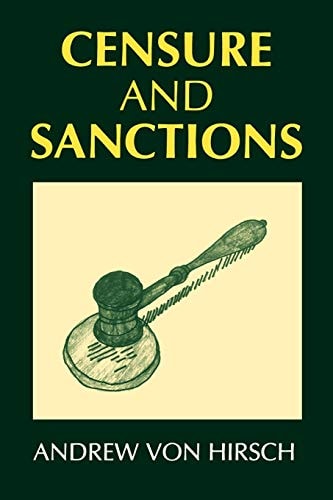
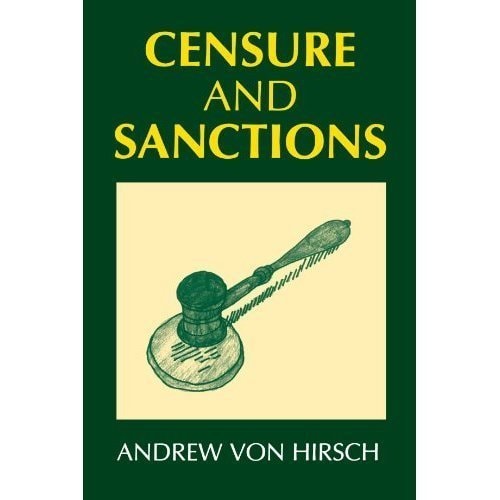
Censure and Sanctions
0
0
As an Amazon Associate and affiliate partner, Menrva Books earns from qualifying purchases. Learn more
Author Description
Andrew von Hirsch addresses a number of emerging conceptual questions concerning the proportionality of criminal sentences, an approach that is gaining influence worldwide including in England where the Criminal Justice Act of 1991 made proportionality the primary criterion for determining sentences. This study deals with how the idea of penal censure justifies proportionate sentences, how a penalty scale should be "anchored" in order to reduce overall punishment levels, how non-custodial penalties should be graded and used, and how political pressures impinge on sentencing policies. It offers a coherent and humane way of allocating punishments, appropriate for a society that treats convicted offenders as citizens whose rights and choices should continue to be respected.
Menrva's Summary
THE THESIS
This work investigates the conceptual foundations of criminal sentencing proportionality and the role of penal censure in a modern justice system. Andrew von Hirsch, a prominent scholar in criminal justice theory, examines how the principle of proportionality serves as a primary criterion for sentencing. He argues for a coherent, humane framework that balances the state's need to punish with the necessity of respecting the rights and citizenship of the offender, particularly in the context of shifting political pressures.
THE SCOPE MAP
What You Will Find
- Analysis of the Criminal Justice Act of 1991 and its impact on sentencing proportionality.
- Methodologies for "anchoring" penalty scales to reduce overall incarceration rates.
- Frameworks for the grading and implementation of non-custodial penalties.
- Examination of the intersection between political policy and judicial sentencing practices.
THE AUTHORITY PERSPECTIVE
Legal scholars and practitioners frequently cite this text as a foundational contribution to the desert-based theory of punishment. Experts highlight the book's clarity in bridging abstract philosophical concepts with the practical realities of legislative sentencing reform.
Page Count:
144
Publication Date:
1996-05-23
Publisher:
Clarendon Press
ISBN-10:
0198262418
ISBN-13:
9780198262411
Criminal Law
Sanctions Law
Sociology
Criminology
Law
Community Tags
Other Editions(3)
Similar Books