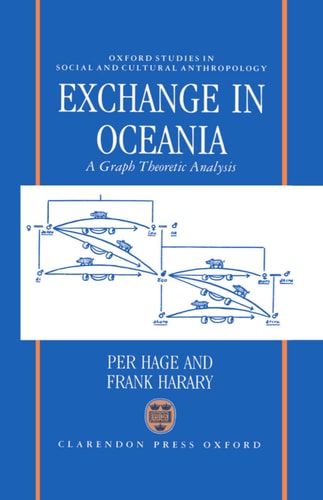
Exchange in Oceania: A Graph Theoretic Analysis
0
0
As an Amazon Associate and affiliate partner, Menrva Books earns from qualifying purchases. Learn more
Author Description
In their previous book, Structural Models in Anthropology, Hage and Haray used graph theory, a branch of pure mathematics, to develop a family of models for the study of social, symbolic, and cognitive relations. With Exchange in Oceania the authors extend these models using ethnographic data from Melanesia, Micronesia, and Polynesia to demonstrate that the language, techniques, and theorems of graph theory provide the essential basis for the description, quantification, simulation, enumeration, and notation of the great variety of exchange forms actually found in Oceanic societies.
Menrva's Summary
THE THESIS
This book investigates whether the formal language and theorems of graph theory can provide a rigorous, quantifiable framework for analyzing the diverse exchange systems found in Oceanic societies. The authors, Per Hage and Frank Harary, build upon their previous collaborative work in structural anthropology to apply mathematical modeling to ethnographic data. By utilizing graph theory, they argue that complex social, symbolic, and cognitive relations can be described, simulated, and enumerated with greater precision than traditional qualitative methods allow. The text serves as a bridge between pure mathematics and cultural anthropology, demonstrating the utility of formal models in understanding social structures.
THE SCOPE MAP
What You Will Find
- Mathematical modeling of social, symbolic, and cognitive relations using graph theory.
- Ethnographic data sets sourced from Melanesia, Micronesia, and Polynesia.
- Methodologies for the quantification, simulation, and notation of exchange forms.
- Comparative analysis of diverse exchange systems within Oceanic cultures.
THE AUTHORITY PERSPECTIVE
Experts in the field recognize this work as a significant contribution to the application of formal mathematical models within anthropological research. Readers frequently note the high level of technical density, as the text requires a foundational understanding of both graph theory and ethnographic study to fully grasp the proposed models.
Page Count:
336
Publication Date:
1991-10-10
Publisher:
Clarendon Press
ISBN-10:
0198277601
ISBN-13:
9780198277606
Social Science
Mathematics
Anthropology
Oceania
Graph Theory
Ethnography
Community Tags
Similar Books