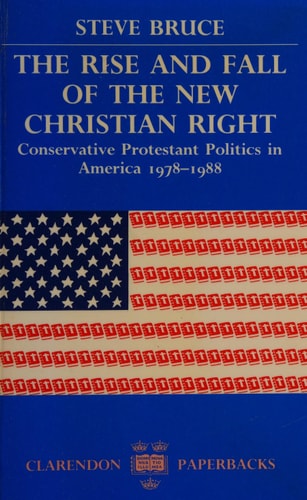
The Rise and Fall of the New Christian Right: Conservative Protestant Politics in America, 1978-1988
0
0
As an Amazon Associate and affiliate partner, Menrva Books earns from qualifying purchases. Learn more
Author Description
The resurgence during the Reagan administration of right-wing organizations--like Jerry Falwell's Moral Majority--committed to bringing religion back into American politics, reflected the determination of fundamentalists to fight against a perceived domination that threatened the autonomy of conservative Protestantism from a liberal and cosmopolitan elite. The fundamentalists, however, have been forced into alliances with conservative Catholics and Jews, and other secular conservatives, in their quest for political strength; and, inherent tensions of this coalition-building effort have worked against the cause, being in large part responsible for the relative failure of the movement to make larger inroads into American popular politics. This important new book draws on survey data and interviews with fundamentalist activists to chart the rise and fall of the New Christian Right. Bruce traces the postwar social and religious origins of the movement, evaluates its achievements, and analyzes why, despite some local successes, it has failed to remake the United States as "one nation under God." He also draws larger conclusions about the political possibilities for religious minorities in modern societies.
Menrva's Summary
THE THESIS
This book investigates the factors that led to the rise and subsequent political stagnation of the New Christian Right in the United States between 1978 and 1988. Steve Bruce, a sociologist specializing in the study of religion, utilizes a combination of survey data and primary source interviews with fundamentalist activists to examine the movement's internal dynamics. He argues that the inherent contradictions of building a broad coalition with secular conservatives and other religious groups ultimately undermined the movement's ability to achieve its long-term goal of reshaping American society.
THE SCOPE MAP
What You Will Find
- An analysis of the postwar social and religious origins of American fundamentalism.
- A detailed examination of the coalition-building strategies between Protestants, Catholics, and secular conservatives.
- Empirical evidence drawn from survey data and direct interviews with movement activists.
- A theoretical framework evaluating the political efficacy of religious minorities in modern democratic societies.
THE AUTHORITY PERSPECTIVE
Scholars and political analysts frequently cite this work as a foundational text for understanding the organizational limitations of the religious right during the Reagan era. Readers often note the academic density of the prose, which provides a rigorous sociological assessment of why the movement failed to achieve its broader national objectives.
Page Count:
224
Publication Date:
1990-07-26
Publisher:
Oxford University Press
ISBN-10:
0198278616
ISBN-13:
9780198278610
History
Religion
Politics
Sociology
American History
Community Tags
Similar Books