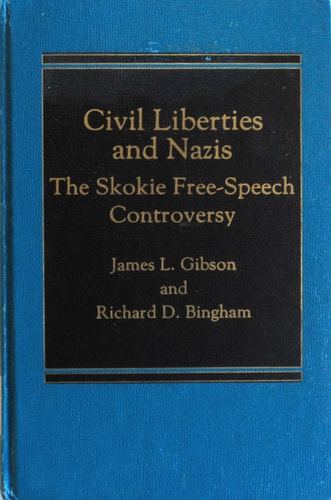
Civil liberties and Nazis: The Skokie free-speech controversy
0
0
As an Amazon Associate and affiliate partner, Menrva Books earns from qualifying purchases. Learn more
Author Description
This study of civil liberties focuses on the American Civil Liberties Union (ACLU) and the dispute in Skokie, Illinois over the rights of members of the Nazi party to hold public demonstrations. Because this issue promoted at least one-fourth of the membership of the ACLU to take some form of action, ranging from objecting and reducing financial contributions to resigning, this conflict presents the opportunity for a case study of the conditions under which attitudes toward civil liberties are mobilized into behavior.
Menrva's Summary
THE THESIS
This study investigates the psychological and social conditions that transform abstract support for civil liberties into concrete political action. Author James L. Gibson, a political scientist, utilizes the 1977-1978 Skokie, Illinois controversy as a primary case study to examine how the American Civil Liberties Union (ACLU) membership responded to the organization's defense of Nazi demonstrators. The work argues that the conflict provides a unique lens through which to analyze the gap between ideological commitment to free speech and the practical application of those principles when confronted with unpopular or extremist groups.
THE SCOPE MAP
What You Will Find
- Analysis of the internal organizational dynamics of the ACLU during the Skokie crisis.
- Quantitative data regarding membership attrition and financial protest.
- Theoretical frameworks for understanding political tolerance and behavioral mobilization.
Scope Limits
- The study does not provide a comprehensive legal history of the First Amendment beyond the specific context of the Skokie case.
- It does not focus on the motivations of the Nazi party members themselves, but rather on the reactions of the civil liberties advocates.
THE AUTHORITY PERSPECTIVE
Scholars and political scientists frequently cite this work as a foundational text for understanding the complexities of political tolerance and organizational behavior. Readers often note the academic density of the prose, which provides a rigorous examination of the tension between institutional mission and individual member values.
Page Count:
227
Publication Date:
1985-01-01
Publisher:
Praeger
ISBN-10:
0030016347
ISBN-13:
9780030016349
History
Politics
Specific Topics
Civil Rights
American History
Sociology
Politics & Government
Law
Community Tags
Similar Books