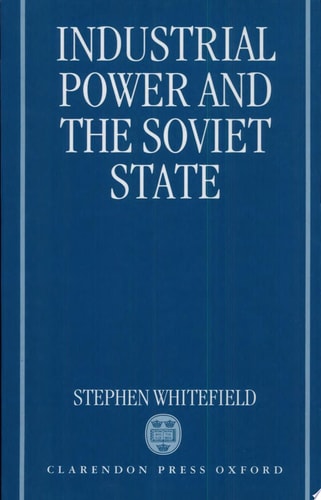
Industrial Power and the Soviet State
0
0
As an Amazon Associate and affiliate partner, Menrva Books earns from qualifying purchases. Learn more
Author Description
This book analyzes the relationship between economic power and political authority in the Soviet system. Stephen Whitefield argues that Soviet politicians' efforts to build their authority in the industrial sector were a key source of political instability, and that perestroika was the last in a series of failed attempts by Soviet leaders to gain control of the behavior of the institutions they had created. The dilemma for Soviet politicians was that their attempts to build authority over industrial actors destabilized society and ultimately resulted in the collapse of the Soviet state itself. But industrial power has outlived the Soviet Union, and this book concludes by showing how industry continues to exert a crucial influence on Russian government and society.
Menrva's Summary
THE THESIS
This book investigates the fundamental tension between economic power and political authority within the Soviet system, specifically examining how industrial control efforts contributed to state instability. Stephen Whitefield, a lecturer in Russian and East European politics, utilizes historical analysis and institutional study to argue that the Soviet leadership's persistent attempts to dominate industrial actors created systemic failures. By tracing the evolution of industrial ministries, the author demonstrates how these power dynamics directly influenced the trajectory of perestroika and the eventual dissolution of the Soviet state.
THE SCOPE MAP
What You Will Find
- Analysis of the Soviet industrial ministry system and its internal power structures.
- Examination of the political consequences of state-led economic management.
- Historical evidence regarding the failure of reform attempts like perestroika.
- Assessment of the enduring influence of industrial power on contemporary Russian governance.
THE AUTHORITY PERSPECTIVE
Experts and political scientists recognize this work as a foundational study of the Soviet industrial apparatus and its role in state collapse. Readers frequently note the academic density of the prose and the persuasive nature of the author's challenge to existing paradigms of Soviet political history.
Page Count:
288
Publication Date:
1993-11-11
Publisher:
Oxford University Press
ISBN-10:
0198278810
ISBN-13:
9780198278818
History
Economics
Industrial history
Industrial Policy
Russia
Soviet Union
Community Tags
Similar Books