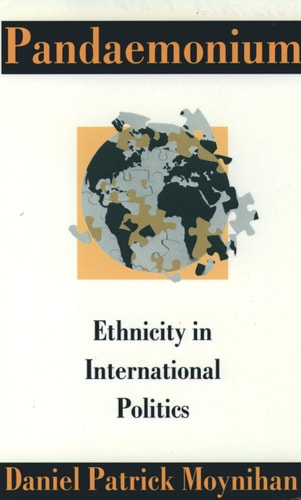
Pandaemonium: Ethnicity in International Politics
0
0
As an Amazon Associate and affiliate partner, Menrva Books earns from qualifying purchases. Learn more
Author Description
Ten years before the Soviet Union collapsed, Senator Daniel Patrick Moynihan stood almost alone in predicting its demise. As the intelligence community and cold war analysts churned out statistics demonstrating the enduring strength of the Moscow regime, Moynihan, focusing on ethnic conflict, argued that the end was at hand. Now, with such conflict breaking out across the world, from Central Asia to South Central Los Angeles, he sets forth a general proposition: Far from vanishing, ethnicity has been and will be an elemental force in international politics.Drawing on a lifetime of scholarship, the Senator provides in Pandaemonium a subtle, richly textured account of the process by which theory has grudgingly begun to adapt to reality. Moynihan--whose previous studies range over thirty years from Beyond the Melting Pot (with Nathan Glazer) to the much acclaimed On the Law of Nations--provides a deep historical look at ethnic conflict around the globe. He shows how the struggles that now absorb our attention have been going on for generations and explain much of modern history. Neither side in the cold war grasped this reality, he writes. Neither the liberal myth of the melting pot nor the Marxist fantasy of proletarian internationalism could account for ethnic conflict, and so the international system stumbled from one set of miscalculations to another.Toward the close of World War I, Woodrow Wilson declared the "self-determination of peoples" to be an Allied goal for the peace. Toward the end of World War II, Josef Stalin inserted "self-determination of peoples" into Article I of the United Nations Charter, defining "The Purposes" of the new world organization. This process has been going on ever since. The first phase, the breaking up of empire, was relatively peaceful. The second phase, presaged by the 1947 partition of India, is certain to be far more troubled, as fifty to a hundred new countries emerge.Moynihan argues, however, that a dark age of "ethnic cleansing" is upon us.
Menrva's Summary
THE THESIS
Daniel Patrick Moynihan investigates the core question of why ethnicity remains an elemental and volatile force in international politics despite the failure of both liberal and Marxist frameworks to account for its persistence. Drawing on his extensive background as a scholar and U.S. Senator, Moynihan argues that the international system has consistently miscalculated the power of ethnic identity. He posits that the post-Cold War era is defined by the fragmentation of states, a process rooted in the historical misapplication of the principle of self-determination.
THE SCOPE MAP
What You Will Find
- Historical analysis of the concept of self-determination from the post-World War I era to the late 20th century.
- A critique of the failure of the liberal melting pot theory and Marxist internationalism to predict state instability.
- Examination of the transition from the peaceful dissolution of empires to the more volatile emergence of new nation-states.
- Case studies and historical evidence illustrating the role of ethnic conflict in modern global politics.
THE AUTHORITY PERSPECTIVE
Experts and political scientists frequently cite this work as a prescient analysis of the ethnic tensions that defined the post-Soviet geopolitical landscape. Readers often note the academic rigor and historical depth Moynihan employs to challenge conventional international relations theory.
Page Count:
240
Publication Date:
1993-02-25
Publisher:
Oxford University Press
ISBN-10:
0198277873
ISBN-13:
9780198277873
History
International relations
Nationalism
Sociology
Ethnicity
Ethnic relations
Community Tags
Similar Books