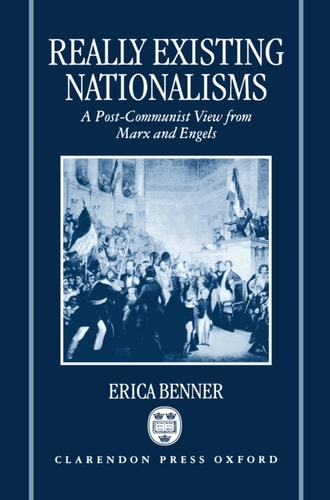
Really Existing Nationalisms: A Post-Communist View from Marx and Engels
0
0
As an Amazon Associate and affiliate partner, Menrva Books earns from qualifying purchases. Learn more
Author Description
This book counters a range of assumptions commonly held about Marx's views of nationalism and internationalism, not least by twentieth-century marxists themselves. It shows that Marx did not envisage the abolition of national communities or nation states; that the politics of nationalism in Marx is not incompatible with a politics of class; that Marx was repeatedly critical of a "utopian" internationalism, and that the themes of nationalism and international solidarity, far from being necessarily in opposition, can be seen in many cases as mutually reinforcing. Nationalism then emerges in Marxist theory as a form of political self-identification and mobilization that can contribute to the broader project of social and political freedom.
Menrva's Summary
THE THESIS
Does the foundational theory of Karl Marx and Friedrich Engels inherently necessitate the rejection of nationalism in favor of a singular, utopian internationalism? Erica Benner, an expert in political theory, challenges the conventional interpretations held by twentieth-century Marxists by re-examining the original texts of Marx and Engels. She argues that their work does not advocate for the abolition of nation-states but rather views nationalism as a complex, often necessary, vehicle for political mobilization and social freedom.
THE SCOPE MAP
What You Will Find
- A rigorous re-evaluation of primary source texts by Marx and Engels regarding national identity.
- Analysis of the historical context surrounding nineteenth-century European nation-state formation.
- A critique of the 'utopian' internationalism often attributed to Marxist doctrine.
- An examination of how class-based politics and national self-identification can function as mutually reinforcing forces.
THE AUTHORITY PERSPECTIVE
Scholars and political theorists recognize this work as a significant corrective to long-standing misinterpretations of Marxist political thought. Readers frequently note the academic density of the prose, which demands a high level of familiarity with both historical materialism and nineteenth-century European history.
Page Count:
266
Publication Date:
1995-01-01
Publisher:
Clarendon Press
ISBN-10:
0198279590
ISBN-13:
9780198279594
History
Communism
Marxism
Political Theory
Nationalism