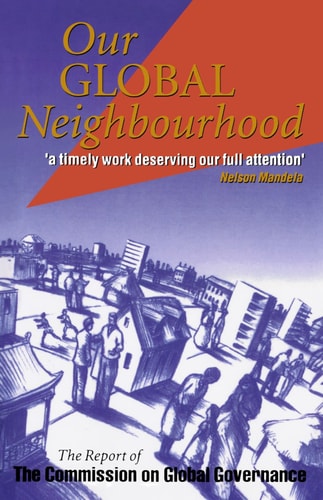
Our Global Neighborhood: The Report of the Commission on Global Governance
0
0
As an Amazon Associate and affiliate partner, Menrva Books earns from qualifying purchases. Learn more
Author Description
Coming to terms with the realities of our new global environment, an environment in which human relationships span the globe and interdendencies and interconnections are multiplying exponentially, will be the greatest challenge of the coming century. Our Global Neighborhood takes the first step in tackling the crucial issues standing in the way of the world community's progress on the eve of the twenty-first century. Its far-reaching recommendations stand as the most thorough attempt to ensure peace and progress around the world since the formation of the United Nations.Conceived by the Commission on Global Governance, this vastly important book represents the collective thinking of twenty-eight eminent international figures from a variety of professional and public affairs backgrounds. Established in 1992 to analyze global changes in recent decades and to suggest ways in which the international community can better cooperate on global issues, the Commission works to capitalize on the myriad opportunities afforded the world community in the wake of the Cold War. Beginning with an analysis of the complex and contradictory effects of globalization and the end of the Cold War, this extensive report outlines the major transformations that have transpired over the last fifty years including the political, economic, military, technological, intellectual, and institutional changes that have so powerfully marked the second half of the twentieth century. In turn, it surveys the major problems, such as ethnic conflict, unemployment, environmental degradation, and extensive population growth, that have emerged from these transformations to confront world leaders.In itself, the end of the Cold War has far from ended the world's problems. While the threat of nuclear superpower war has receded, the spread of nuclear capability and of biological and chemical weapons poses great dangers. Wars, between states and even more within states (such as the ongoing tragedy of both Yugoslavi
Menrva's Summary
THE THESIS
This report investigates how the international community can restructure global governance to address the complex, interconnected challenges of the post-Cold War era. The Commission on Global Governance, comprised of twenty-eight international figures, synthesizes decades of geopolitical, economic, and technological data to propose a framework for enhanced cooperation. By analyzing the shift from superpower-dominated conflict to decentralized global instability, the authors argue for a modernized institutional approach to peace, security, and sustainable development.
THE SCOPE MAP
What You Will Find
- An analysis of post-Cold War political, economic, and military transformations.
- A comprehensive survey of global threats including ethnic conflict, environmental degradation, and population growth.
- Policy recommendations for reforming international institutions like the United Nations.
- A framework for addressing the proliferation of nuclear, biological, and chemical weapons.
THE AUTHORITY PERSPECTIVE
Experts recognize this report as a foundational document for understanding the institutional challenges of late 20th-century international relations. Readers frequently note the academic density of the prose and the breadth of the commission's policy recommendations.
Page Count:
432
Publication Date:
1995-02-16
Publisher:
Oxford University Press
ISBN-10:
0198279973
ISBN-13:
9780198279976
History
International relations
Public Policy
International Cooperation
Globalization
Community Tags
Similar Books